Waterproof M12 Lens with IR-Cut Filter: IP-Rated Solution for Harsh Environments
Waterproof M12 Lens with IR-Cut Filter: Finding the Right IP-Rated Optical Solution for Harsh Environments
A standard M12 lens delivers excellent optics — the right field of view, low distortion, high resolution. Then the deployment environment changes: outdoor installation, washdown requirements, or simply humidity exposure. Suddenly, the same lens becomes a liability. The search for a waterproof M12 lens with an IR-cut filter begins, and with it comes the concern that image quality, sensor compatibility, or enclosure design must be compromised.
The reality is more nuanced. Several engineering paths exist between keeping the original optical design and adopting a standard IP-rated alternative. The right choice depends on how much of the original lens performance must be preserved and how much system requalification the project can absorb.
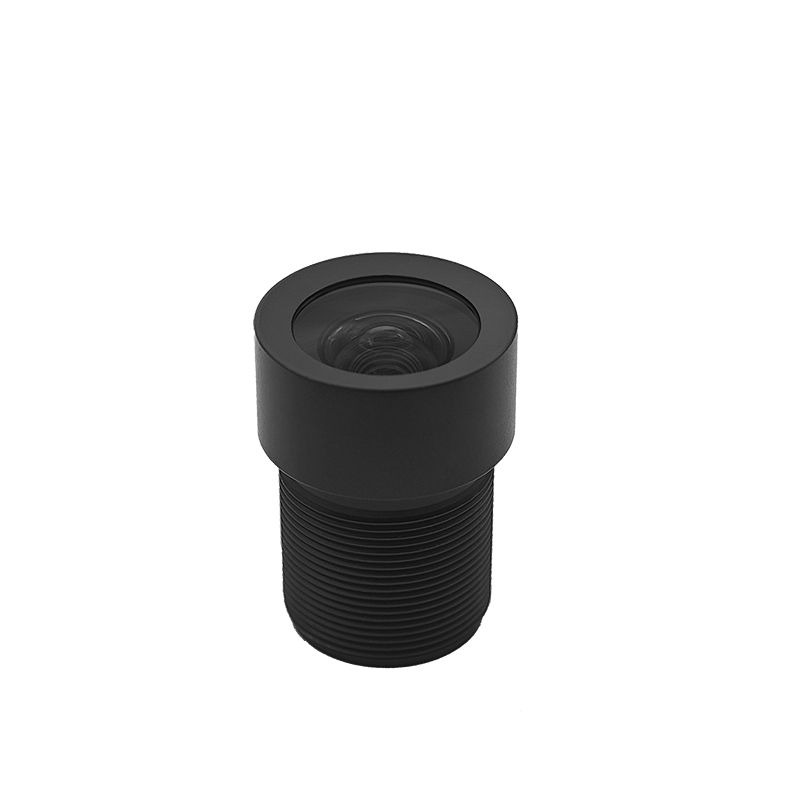
Why Standard M12 Lenses Struggle in Outdoor and Washdown Environments
M12 (S-Mount) lenses serve as the optical core of compact imaging systems across security, machine vision, drone, medical, and smart retail applications. Their standardized thread interface and small footprint make them the default choice for camera module integration.
However, standard M12 lenses present three recurring limitations in harsh environments:
No ingress protection — Most catalog M12 lenses use unsealed barrel construction. There are no O-rings, gaskets, or sealants between optical elements or at the thread interface. Moisture, dust, and condensation enter freely.
IR-cut is a late addition — When IR-cut functionality is needed, engineers typically add an external mechanical filter holder or omit it entirely. Factory-integrated solutions are rare in standard catalogs.
Model switching introduces optical risk — Replacing one M12 lens with another that "fits the thread" does not guarantee matching sensor coverage, FOV, distortion profile, or resolution. The optical chain must be revalidated from scratch.
The apparent trade-off — protection versus optical fidelity — is what makes this a genuine engineering decision rather than a simple component swap.
What to Look for in a Waterproof M12 Lens with IR-Cut Filter
When evaluating an IP-rated M12 lens, the following criteria should be assessed in order of system impact:
1. IP Rating — IP55 vs IP67 vs IP68
IP55 — Partial dust protection and resistance to low-pressure water jets. Suitable for light outdoor exposure or splash-prone indoor environments where failure is non-critical.
IP67 — Full dust seal (dust-tight) and protection against temporary immersion (1 meter for 30 minutes). This is the practical baseline for outdoor security, agricultural sensors, and industrial washdown zones. Most available IP-rated M12 lenses target this level.
IP68 — Continuous immersion protection. Typically unnecessary unless the camera module operates underwater.
2. Sensor Image Circle Compatibility
The lens must project an image circle that meets or exceeds the sensor's diagonal. A 1/1.8" sensor requires a minimum Ø9.0 mm image circle. Any mismatch forces a sensor change or a redesign of the optical system.
3. Field of View and Focal Length
The original lens was selected for a specific angular coverage — wide-area monitoring, distance-to-target geometry, or multi-camera stitching. A replacement must preserve this angular relationship or the entire system layout changes.
4. Distortion Profile
For measurement, barcode reading, stitching, or any geometrically sensitive application, distortion is a system-level parameter. Switching from a low-distortion lens (< 1%) to a generic wide-angle lens can break calibration and image processing pipelines. The target is a near-zero distortion lens wherever possible.
5. Factory-Integrated IR-Cut
An internally mounted IR-cut filter eliminates separate assembly steps, reduces mechanical complexity, and improves reliability. The filter specification (cut-on wavelength, coating type, transmission band) should be matched to the sensor's spectral response for balanced day/night imaging.
Two Engineering Paths to a Waterproof M12 Lens with IR-Cut
A recent inquiry involved a customer using the JSD4218 — a 4.2mm, 12MP, ultra-low-distortion M12 wide-angle lens — who needed to add IP55+/IP67 protection and IR-cut capability without starting from scratch. Two distinct engineering paths were evaluated. Both achieve the environmental goal, but they address different project constraints.
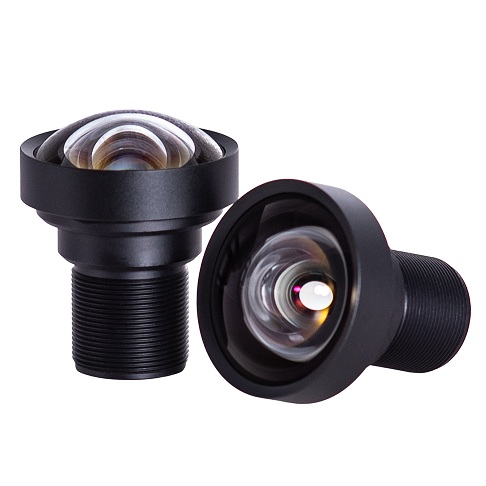
Path 1: The Drop-In Replacement — JSD5426 with IR-Cut Customization
For projects that can accept a slight change in FOV and aperture while keeping the same sensor interface and thread, the JSD5426 offers a standard, production-ready IP67 solution.
| Parameter | JSD5426 | System Impact |
|---|---|---|
| Focal Length | 5.40 mm | Slightly narrower FOV (80° diagonal vs. 96°), still classified as wide-angle |
| F# | 2.6 | One stop slower than the original — acceptable in well-lit outdoor scenes |
| Sensor Support | 1/1.8" (Ø9.0) | Same image circle — no sensor or optical redesign needed |
| Distortion | < -0.17% | Near-zero — geometric accuracy is preserved |
| Resolution | 8MP | Lower than 12MP, but sufficient for most surveillance and inspection use cases |
| IP Rating | IP67 | Dust-tight and immersion-proof |
| IR-Cut | Customizable | Factory-integrated filter available on request |
| Housing Size | φ14 × 23.55 mm | More compact than the original |
| Interface | M12 (Standard) | No mounting or enclosure changes required |
Best suited for:
Systems already using 1/1.8" or smaller sensors
Applications where a 16° FOV reduction is acceptable
Projects that prioritize standard parts availability and shorter lead times
Outdoor surveillance, smart agriculture, and industrial inspection deployments
Path 2: Custom Modification — JSD4218 Upgraded to IP67 with IR-Cut
For projects that cannot sacrifice the original 96° FOV, 12MP resolution, or specific distortion characteristics, a custom engineering route is available. This involves modifying the JSD4218 housing and assembly process to achieve sealed IP67 performance without altering the optical design.
The modification includes:
Redesigning the barrel assembly to incorporate sealing elements (O-rings, thread sealants, bonded interfaces)
Adding an internal IR-cut filter during the optical assembly stage
Retaining the original 8-element hybrid glass-plastic design with its measured optical performance
Best suited for:
Systems that depend on the exact 96° FOV for coverage or multi-camera stitching
High-resolution applications requiring the full 12MP output (aerial mapping, high-detail inspection)
Projects where original lens validation is complete and requalification costs must be minimized
Applications requiring the faster F1.8 aperture (e.g., low-light environments)
Application Scenarios Where This Matters
Outdoor Security and Surveillance
Constraint: Outdoor cameras face rain, dust, condensation, and temperature cycling. Without a sealed lens, moisture ingress degrades image quality over weeks to months. Daytime color accuracy depends on effective IR filtration.
Engineering approach: The JSD5426 with IP67 housing and factory IR-cut filter provides reliable day/night operation in a compact M12 package. The low-distortion profile also simplifies panoramic stitching for multi-camera setups.
Agricultural and Environmental Monitoring
Constraint: Field-deployed sensors operate under constant dust exposure, irrigation spray, and condensation. Unsealed lenses fog internally and fail within a single growing season.
Engineering approach: An IP67-rated M12 lens eliminates internal fogging. The IR-cut option enables accurate NDVI measurements by blocking unwanted IR wavelengths during daylight capture.
Industrial Washdown Zones
Constraint: Food processing, pharmaceutical, and automotive facilities require high-pressure washdown. Optical systems must survive direct spray without degradation.
Engineering approach: A sealed IP67 M12 lens (either the standard JSD5426 or a custom-modified JSD4218) removes the need for a protective housing, reducing system size and BOM cost.
Smart Retail and Outdoor Kiosks
Constraint: EV charging stations, ticketing kiosks, and access control terminals operate in rain, snow, and dust while requiring accurate image capture for authentication or inventory tracking.
Engineering approach: A compact, low-distortion, waterproof M12 lens with IR-cut fits within the tight mechanical envelope of a kiosk while maintaining consistent imaging across variable lighting.
Selection Guidance: How to Choose the Right Waterproof M12 Lens
| Priority | Recommended Path |
|---|---|
| Minimize design changes | Path 1: JSD5426 (same sensor, same mounting, similar FOV) |
| Preserve 96° FOV | Path 2: JSD4218 custom IP67 + IR-cut |
| Retain 12MP resolution | Path 2: JSD4218 custom |
| Standard product / faster lead time | Path 1: JSD5426 |
| Smallest housing diameter | Path 1: JSD5426 (φ14 vs φ22) |
| Higher light throughput (lower F#) | Path 2: JSD4218 custom (F1.8 vs F2.6) |
Trade-Off Summary
Every sealed lens design involves optical-mechanical compromises. The JSD5426 achieves IP67 in a compact, standard form factor but delivers a narrower FOV (80° vs 96°) and one stop less light. The custom JSD4218 preserves the original optical performance and adds sealing, but requires a development cycle. Neither path is universally superior — the correct choice depends on system-level priorities rather than component-level specifications alone.
Why JSD Optical for Waterproof M12 Lens Projects
Selecting a waterproof M12 lens with IR-cut capability goes beyond matching thread size and focal length. It requires evaluating sensor compatibility, mechanical integration, sealing methodology, and production repeatability.
Engineering-led evaluation — JSD Optical provides sensor-specific compatibility analysis rather than generic product recommendations. MTF, distortion, and relative illumination data are shared for engineering validation.
Standard and custom capability — If a catalog product meets the requirement, it can be sampled quickly. If not, JSD's in-house optical and mechanical engineering resources can modify an existing design or develop a new one.
IR-cut integration expertise — Adding an internal IR-cut filter to a sealed M12 lens demands precise alignment and clean assembly. This capability is available as a standard option across multiple product lines, not a one-off experiment.
IP67 validation — Sealed lenses undergo ingress testing to verify the IP rating. Documentation is available for system qualification.
FAQ
Q: Is IP55 sufficient, or is IP67 recommended for M12 lenses?
IP67 provides a higher level of protection (dust-tight and immersion-proof vs. limited dust and splash protection). Most available IP-rated M12 lenses are designed to IP67 by default. Using a lens rated above the minimum requirement adds margin without significant cost or size increase in most cases.
Q: Does an IR-cut filter affect the lens optical performance?
A factory-integrated IR-cut filter is designed as part of the optical system. It blocks wavelengths above approximately 700nm to prevent color distortion in daytime imaging. For day/night systems, the filter can be mechanically switched. JSD Optical can customize the filter specification to match the sensor's spectral response curve.
Q: What if a different FOV or focal length is needed?
Both JSD5426 and JSD4218 are wide-angle lenses. For narrower FOV requirements, JSD also offers IP67-rated lenses such as the JSD8028 (8mm, 58° FOV, 1/1.8", 8MP) with IR-cut customization available. The engineering team can evaluate specific requirements upon request.
Q: How is sensor compatibility verified?
The sensor datasheet specifies the image circle diagonal (e.g., 1/1.8" = Ø9.0 mm). The selected lens must project an image circle equal to or larger than this value. JSD Optical provides full optical data including MTF curves, distortion plots, and relative illumination charts to support compatibility evaluation.
Q: Can the JSD5426 be tested with an existing sensor before ordering?
Yes. Sample evaluation is available for qualified projects. Specifications and project details can be submitted to info@jsdoptical.com for review.
Whether the best fit is the JSD5426 as a standard IP67 replacement or a custom waterproof version of the JSD4218 with IR-cut integration, the decision process begins with a review of the original lens specifications, sensor parameters, environmental requirements, and system constraints.
Provide the original lens model, sensor size, target IP rating, and IR-cut requirements. The engineering team will evaluate both standard and custom paths — and recommend the solution that best aligns with the project's optical and mechanical priorities.
📩 Get your project evaluated — Contact the JSD optical engineering team .
Or send your specifications directly to info@jsdoptical.com .
🔍 Explore the full range of IP-rated optical solutions: View All Products .
 Consult now