Wide-Angle Lenses for IMX219: Solving Focus Drift in CSI Interface Modules
In embedded development for platforms like the Raspberry Pi (V2) and NVIDIA Jetson Nano, the Sony IMX219 is the most widely used 8-megapixel sensor model. However, when replacing the stock narrow-angle lens with a wide-angle M12 Lens, developers frequently encounter severe "focus drift" or "focal plane shift." This not only degrades image quality but also leads to failure in AI algorithms when detecting objects at the edges of the frame.
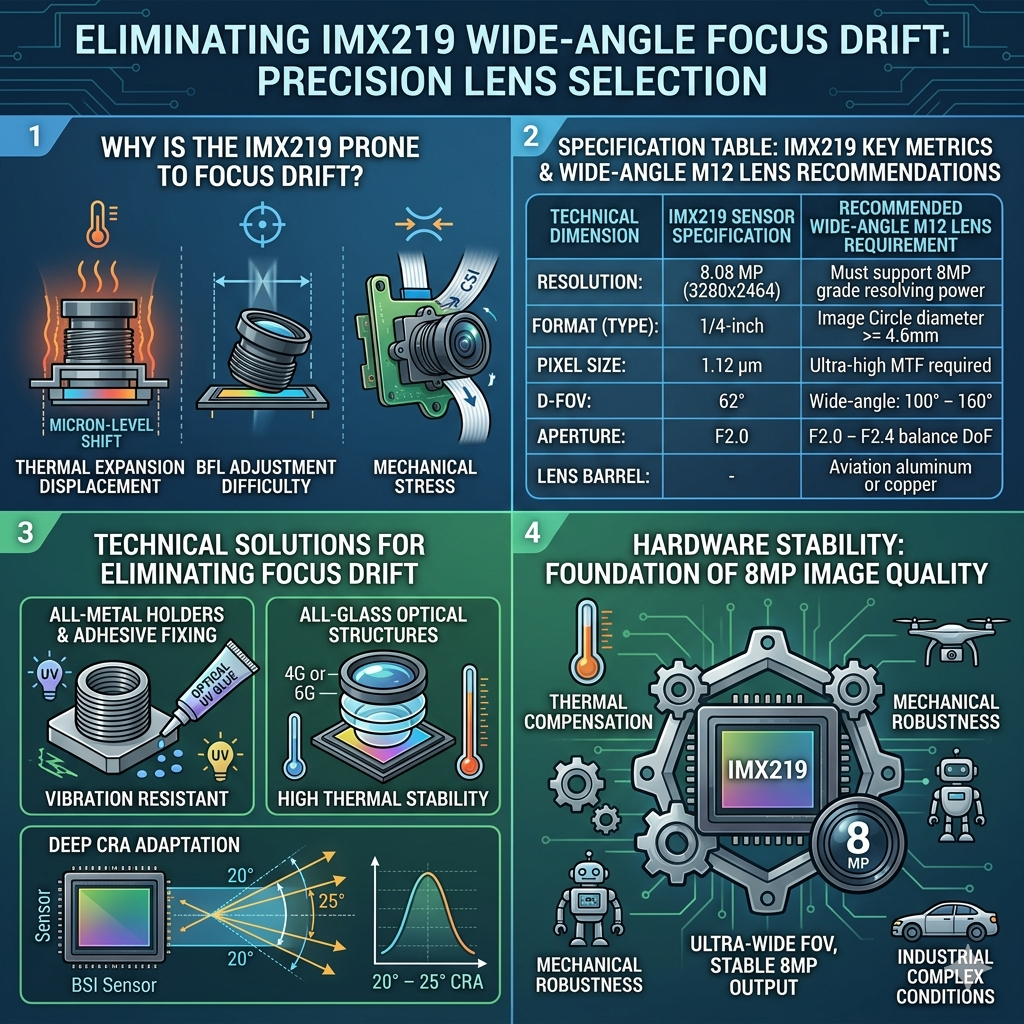
1. Why is the IMX219 Module Prone to Focus Drift?
When using IMX219 modules with CSI interfaces, focus drift is typically caused by three physical factors:
Thermal Expansion Displacement: The IMX219 generates significant heat during prolonged operation (especially during high-resolution or high-frame-rate sampling). When using cheap plastic mounts or lens barrels, thermal expansion causes micron-level shifts in the distance between the lens and the sensor.
Difficulty in BFL (Back Focal Length) Adjustment: The IMX219 has a small photosensitive area (1/4"), resulting in an extremely narrow Depth of Focus. Slight loosening or tilting of the M12 lens threads during installation leads to peripheral blurring.
Mechanical Stress: Tension from the CSI ribbon cable can be transferred through the module bracket to the lens, causing the optical axis to deflect.
2. Specification Table: IMX219 Key Metrics & Wide-Angle M12 Lens Recommendations
To ensure precision during the selection process for the IMX219, refer to the following parameters:
Technical Dimension | IMX219 Sensor Specification | Recommended Wide-Angle M12 Lens Requirement |
Resolution | 8.08 MP (3280 * 2464) | Must support 8MP grade resolving power |
Sensor Format (Type) | 1/4-inch | Image Circle diameter ≥ 4.6mm |
Pixel Size | 1.12 μm * 1.12 μm | High pixel density requires ultra-high MTF values |
Field of View (D-FOV) | 62° (Stock) | Recommended wide-angle: 100° – 160° |
Aperture Value | F2.0 (Typical) | F2.0 – F2.4 recommended to balance Depth of Field |
Lens Barrel Material | - | Aviation aluminum or copper recommended |
3. Technical Solutions for Eliminating Focus Drift
To fundamentally resolve the focus drift issues in wide-angle IMX219 modules, we recommend optimizing at the M12 lens hardware level:
A. Introduce All-Metal Holders and Adhesive Fixing: Replace the stock plastic clip-on mounts with threaded Metal M12 Holders. The thermal expansion coefficient of metal is significantly lower than that of plastic, effectively resisting thermal drift. Once focus is achieved, apply Optical UV Glue at three points on the thread to prevent mechanical focus drift caused by vibrations.
B. Select All-Glass (All-Glass) Optical Structures: To match the high pixel density of 8MP, wide-angle lenses should prioritize 4G (4-element glass) or 6G structures. Glass lenses are highly insensitive to temperature variations, ensuring the focal plane remains locked on the IMX219 sensor from startup through long-term operation, preventing image quality degradation due to environmental temperature shifts.
C. Deep Adaptation of Chief Ray Angle (CRA): The IMX219 is a Back-Illuminated (BSI) sensor that has specific requirements for light incidence. If the wide-angle lens's CRA does not match the sensor, peripheral pixels will suffer from "light interception failure," manifesting as edge blurring and severe chromatic aberration. Always verify that the lens's CRA curve falls within the 20° – 25° range during selection.
4. Hardware Stability: The Foundation of 8MP Image Quality
The core to solving focus drift in IMX219 modules lies in "thermal compensation" and "mechanical robustness." By utilizing all-metal structures and high-resolution all-glass wide-angle lenses, you not only achieve an ultra-wide field of view but also ensure stable 8-megapixel output across the most complex industrial operating conditions.
 Consult now