Selection Essentials for Ultra-Lightweight M12 Lenses Optimized for IMX415
In the development of UAVs (drones), wearable devices, and portable handheld terminals, the Sony IMX415 has become the preferred solution for vision systems due to its exceptional 4K resolution and compact package size. However, to unleash true 4K performance within a limited weight budget, the M12 Lens selection must find a precise balance between "optical quality" and "lightweight design."
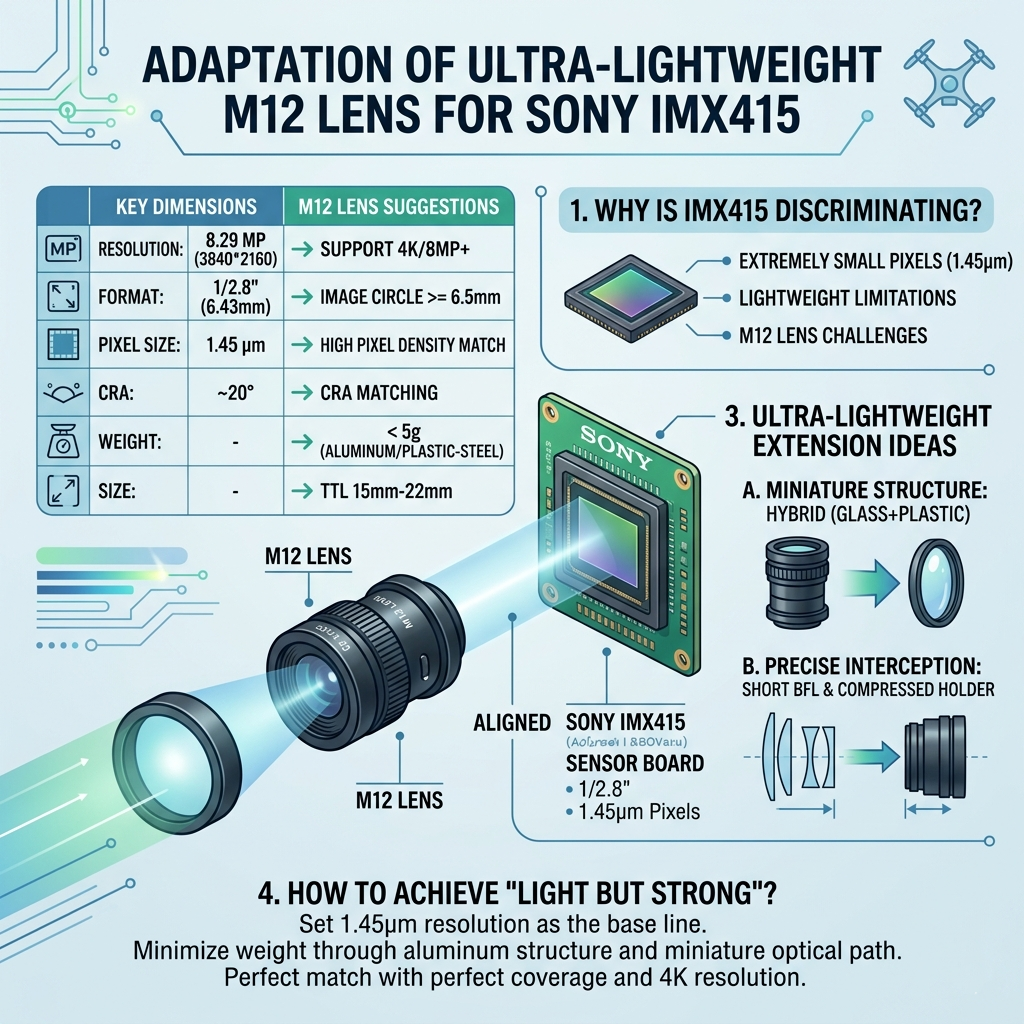
1. Why is the IMX415 So Demanding on M12 Lenses?
The Sony IMX415 is a 1/2.8-inch stacked CMOS sensor. Its primary technical challenges include:
Extremely Small Pixel Size: At only 1.45μm, the lens's resolving power (MTF) must be exceptionally high to clearly project 4K details within such a small unit area.
Lightweight Constraints: In weight-sensitive applications, bulky C/CS-mount lenses are usually not an option. While the M12 lens is the only viable choice, miniaturization often comes at the cost of peripheral image quality.
2. Specification Table: Core Reference Metrics for IMX415 Lens Matching
To ensure the system maintains image quality while remaining lightweight, we recommend filtering lens options based on the following parameters:
Technical Dimension | IMX415 Sensor Requirement | Recommended M12 Lens Index |
Resolution | 8.29 MP (3840 * 2160) | Must support 4K/8MP or higher |
Image Format | 1/2.8" (6.43mm Diagonal) | Image Circle diameter ≥ 6.5mm |
Pixel Size | 1.45μm * 1.45μm | Cut-off frequency must match high pixel density |
Chief Ray Angle (CRA) | Approx. 20° (varies by version) | Lens CRA must closely match the sensor to prevent shading |
Weight | - | Recommended < 5g (using aviation aluminum or high-strength plastic-steel barrels) |
Structural Size | - | Recommended Total Track Length (TTL) between 15mm - 22mm |
3. Strategies for Ultra-Lightweight Solutions
A. Structural Miniaturization Since the IMX415 features a medium-sized 1/2.8" format, a Hybrid (Glass-Plastic) optical design is a viable strategy for M12 lenses. By using glass for core optical path elements and high-quality optical plastics for correction lenses, one can significantly reduce the lens's self-weight while maintaining 4K resolving power.
B. Precise BFL and Holder Integration In ultra-lightweight structures, the height of the lens Holder should be compressed as much as possible. Selecting an M12 lens with a Short BFL (Back Focal Length) effectively lowers the center of gravity for the entire vision module, enhancing stability in high-vibration environments.
4. Achieving "Light yet Powerful"
The golden rule for IMX415-based 4K vision solutions is: Use the $1.45\mu m$ pixel resolution as the baseline, and achieve physical weight reduction through aluminum structures and miniaturized optical paths.
A successful precision fit is only achieved when the M12 lens image circle perfectly covers the 1/2.8" format and the resolving power meets the 4K benchmark.
1. JSD2528-4K (Nominal 8MP / 4K Grade)
Reason for Selection: This is one of the models that best matches the pixel density requirements of the IMX415. Specifically designed for 1/2.8" sensors, it perfectly covers the 6.43mm image diagonal, ensuring 4K resolution and detail clarity from the center to the edges.
Applications: Drone aerial photography, handheld 4K recording devices.
2. JSD1105-4K (Ultra-Wide Angle 4K Solution)
Reason for Selection: For applications requiring a large Field of View (FOV), this lens delivers high optical resolution while maintaining a compact M12 form factor. Its image circle is highly compatible with the IMX415, representing an ideal balance between lightweight design and wide-angle performance.
Applications: Panoramic cameras, action cameras, drone obstacle avoidance, and visual positioning.
3. JSD2120 / JSD1526 (Balanced Selection)
Reason for Selection: These lenses typically feature aviation-grade aluminum barrels, meeting the "weight < 5g" requirement mentioned in your criteria. With a TTL (Total Track Length) controlled at approximately 20mm, they are perfectly suited for wearable devices with strict module height constraints.
Applications: Smart helmets, lightweight industrial handheld terminals.
 Consult now