JSD1611 1.5mm F1.1 M8 Lens for 1/6-inch 2MP Modules
JSD1611 1.5 mm F1.1 M8 Lens for 1/6" Sensor Modules
A fixed-focal M8 design that carries an F1.1 aperture on a 9.6 mm optical stack, for 1/6" modules that still have to produce a frame once the light drops.
Key takeaway: On a 1/6" imager the scarce resource is light, not field of view. The JSD1611 pairs a 1.5 mm focal length with an F1.1 aperture — about 4.8 times the aperture area of an F2.4 design on the same sensor — and holds a 91° diagonal field from a 9.6 mm total track length inside an M8 × P0.35 thread. Two figures set where the design stops: a Φ3.4 mm image circle measured against a Ø3.2 mm active area, and a distortion value of <−5.4% that enters the rectification budget rather than a sales line.
1. The Engineering Problem: A 1/6" Module Has Almost No Room for Light
Miniature camera modules — door viewers, biometric terminals, wearables, laptop cameras, low-power IoT sensors — have converged on the 1/6" imager class because the die is small, inexpensive and draws little current. That choice carries a fixed cost. A 1/6" part presents an active area of roughly Ø3.2 mm, so every pixel sits behind a fraction of the light that would reach a 1/3" sensor with the same scene and the same aperture.
Two levers recover that light: larger pixels, or a faster lens. Pixel decisions belong to the sensor roadmap and are normally frozen before the optics are discussed, which leaves the f-number as the lever still open to the module designer. On a fixed-focus miniature camera the aperture is not a stylistic choice; it sets whether a night-time frame is usable at all.
Three failure modes recur when a 1/6" module is pushed into a thin enclosure:
Aperture carried over by habit. An F2.4 lens inherited from a daylight product leaves the night frame to gain, and gain is where noise enters the image chain.
Image circle that does not match the active area. A circle narrower than the sensor diagonal darkens the corners; one far wider than the diagonal spends glass and barrel on pixels that do not exist.
An optical stack longer than the housing allows. The front face of the product then grows to accommodate the lens, which is the dimension a compact camera cannot give away.
The JSD1611 answers the first two directly; its 9.6 mm total track length answers the third. The sections below work through the published figures, what each one changes in a housing design, and the point at which a catalogue part becomes a project item.
On a 1/6" imager the lens is not there to add field of view. It is there to put enough light on a very small active area, and to do it inside a module that has no spare depth.
— JSD Optics engineering note2. Read the Sensor and the Light Budget Before the Lens
Sensor-first selection starts with the imager part number and its active diagonal, because every other number is measured against that. In the 1/6" class the active area is around Ø3.2 mm diagonal. The format is common enough that specific parts appear in nearly every project brief, and the GalaxyCore GC0328 is the part named on the JSD1611 datasheet page.
Aperture area scales with the square of the f-number at a fixed focal length, so ranking two candidate lenses is arithmetic rather than opinion. Taking F1.1 as the reference:
| Aperture | Aperture area relative to F1.1 | Stops below F1.1 | What it costs the frame |
|---|---|---|---|
| F1.1 | 1.00 | 0.0 | Shortest exposure or lowest gain for a given scene |
| F1.2 | 0.84 | 0.1 | Negligible loss |
| F1.4 | 0.62 | 0.7 | Half a stop of exposure headroom |
| F1.6 | 0.47 | 1.1 | Roughly one stop, the usual cost of a simpler stack |
| F2.0 | 0.30 | 1.7 | Motion blur returns to hand-held night capture |
| F2.4 | 0.21 | 2.3 | Common in the 1/6" class; needs gain or longer exposure |
| F2.8 | 0.15 | 2.7 | Daylight-first designs |
The table is the arithmetic of aperture area at a fixed focal length and scene. It describes how much light the aperture passes, not the measured sensitivity of any particular camera. The practical reading is direct: a night frame shot at F2.4 needs roughly 2.3 stops more exposure time or gain than the same frame at F1.1, and on a 1/6" sensor that gap usually separates a recognisable image from a noisy one.
The second number to check is the image circle. A 1/6" part wants coverage of about Ø3.2 mm, and the JSD1611 is specified at Φ3.4 mm. That 0.2 mm is alignment tolerance, not headroom for a larger format: a roadmap that later moves to a 1/4"-class imager needs a wider circle, which is a different part in the family rather than a setting on this one.
Working in that order — diagonal, then light budget, then mechanical envelope — keeps the lens decision cheap. Reversing it means a housing is designed around an optic that cannot produce the frame the application needs.
3. What the JSD1611 Numbers Change in a Miniature Module
The JSD1611 is a fixed-focal M8 thread design for the 1/6" sensor class, rated for 2 MP imagers, specified at 9.6 mm total track length with a Φ3.4 mm image circle. Each published figure maps onto one decision in the module:
| Parameter | Published value | What it changes in the design |
|---|---|---|
| Effective focal length | 1.5 mm | Sets the 91° diagonal and 77° horizontal field on a 1/6" imager |
| Aperture | F1.1 | Light budget: about 2.3 stops above an F2.4 design on the same sensor |
| Field of view | 91° D / 77° H | Holds a corridor or a doorway face in one frame without fisheye compression |
| Image circle | Φ3.4 mm | Sets the glass and barrel width the 1/6" active area needs |
| Mount | M8 (S-mount) × P0.35 | Fixes the holder interface and the focus method at assembly |
| Total track length | 9.6 mm | Depth from the sensor plane to the front of the barrel |
| Resolution rating | True 2 MP | Matched to 2 MP-class 1/6" imagers |
| Distortion | <−5.4% barrel | A rectification budget line at the published condition |
| Back focal length | Contact for details | Required before the holder drawing is released |
One row in that table is a ceiling rather than a feature. The true 2 MP rating describes what the optical chain resolves on a 1/6" imager of that class, so it belongs next to the imager choice rather than beside the pixel count on a data sheet.
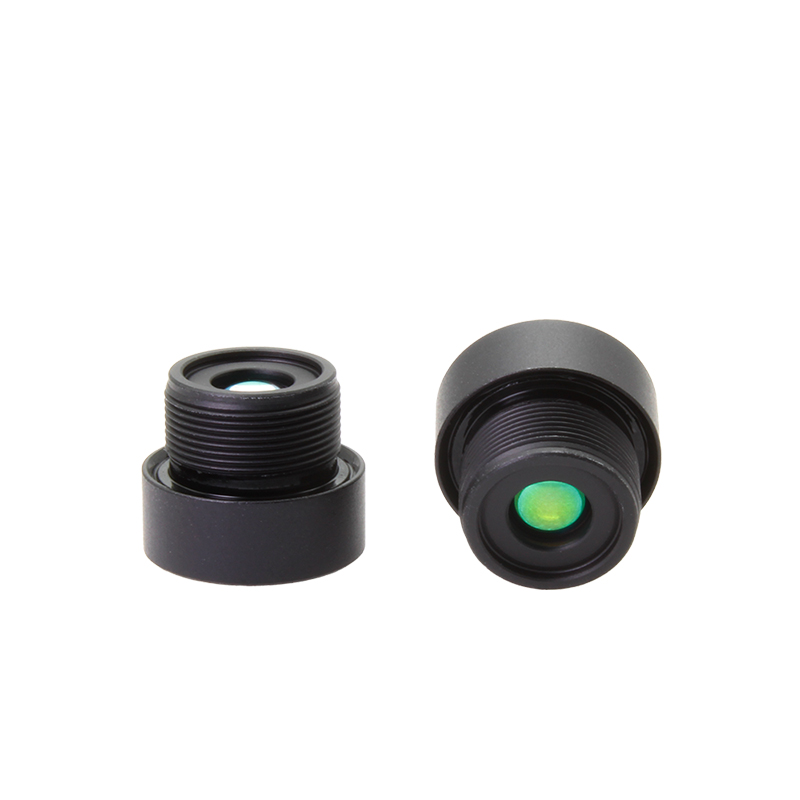
F1.1 on a 1/6" imager is a two-stop decision
An F1.1 aperture is a design commitment before it is a light figure: it constrains element diameters, glass choice and depth of focus, which is why it does not appear as an option on a slower optical formula. On a fixed-focus module it also puts an upper bound on the aperture that the holder tolerance can support, so the same figure that raises the light budget tightens what the assembly has to hold.
It is worth being precise about what the aperture does and does not deliver. The lens passes the light; the imager and the image pipeline decide what the finished frame looks like. A brighter aperture raises the ceiling on what a 1/6" module can do at night, and the frame that comes out still depends on the sensor, its exposure control and the processing behind it.
91° keeps straight lines readable
On a 1/6" imager a 1.5 mm focal length resolves to a 91° diagonal and 77° horizontal field: wide enough to hold a doorway, a corridor or a face at conversational distance in one fixed frame, and short of the fisheye range where corner detail is compressed beyond practical use.
Distortion is published as <−5.4% barrel at a stated condition. A face detector, a barcode reader or a measurement routine that assumes straight lines normally carries a correction model as standard practice, and the published figure tells the pipeline how much of a budget that model has to absorb. Verifying the figure against the same condition used in that model is the step that keeps the two consistent.
4. Fitting the Optic: 9.6 mm Track, M8 Thread and a Φ3.4 mm Circle
The thread carries the focus adjustment
M8 × P0.35 is the smallest common S-mount, and on a fixed-focus miniature module it does two jobs at once: it is the mechanical interface to the holder, and it is the only focus adjustment in the assembly. Focus is set by rotating the barrel in the holder until the image plane lands on the sensor, then locking it. The holder therefore needs enough thread engagement for that rotation to be stable and a defined seating face for the locked position.
Depth of focus scales with f-number, so behind a given pixel pitch the image-side tolerance at F1.1 is tighter than it would be at F2.4. The axial stack-up — holder seat depth, thread engagement, sensor seating and board thickness — becomes part of the image budget, and the focus station has to resolve it. This is a normal consequence of a fast aperture on a small format rather than a property of one vendor's part.
Nine point six millimetres sets the module depth
Total track length is the number the industrial designer feels. At 9.6 mm from sensor plane to barrel front, the module can sit behind a thin front face, which is what makes the part relevant to door viewers, wearables and slim laptop cameras. The items to verify against that figure are the seat depth in the holder, the clearance between the barrel shoulder and the board, the thickness of any front window or cover glass, and the tolerance stack between them.
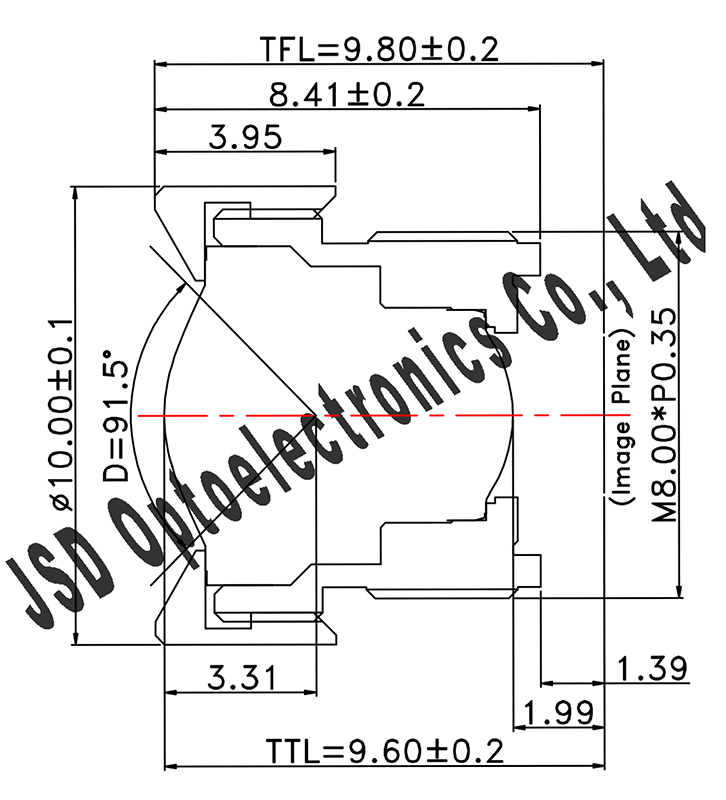
Image circle margin is coverage, not headroom
On a fixed-focus part, a small margin over the active diagonal is the intended result rather than a shortfall: it absorbs assembly and alignment tolerance without spending glass on field that no pixel receives. The step up to a 1/4"-class imager is a change of image circle and barrel diameter together, which is why the wider 1/6" and small-format range is where that decision is made.
5. Brightness or Resolution: JSD1611 Against a Higher-Resolution 1/6" Part
The most useful comparison for the JSD1611 is not a lens from another format but the other native 1/6" design in the same catalogue, the JSD1224. Both are built for the same class of imager and the same named sensor part; they answer different questions.
| Decision | JSD1611, 1.5 mm at F1.1 | JSD1224, 1.17 mm at F2.4 |
|---|---|---|
| Light on the sensor | About 4.8× the aperture area of F2.4 | Needs roughly 2.3 stops more exposure or gain |
| Field of view | 91° diagonal, 77° horizontal | 120° diagonal, 96° horizontal |
| Resolution rating | True 2 MP | 5 MP |
| Mount | M8 (S-mount) × P0.35 | M7 |
| Total track length | 9.6 mm | 9.74 mm |
| Distortion | <−5.4% barrel | <−10.52% barrel |
| Decision it settles | Dim scenes behind a 2 MP 1/6" imager on an M8 holder | Wider field and a 5 MP frame where light allows |
That table describes a trade rather than a ranking. A dim room behind a 2 MP 1/6" imager is settled by the F1.1 aperture and the M8 interface, and the narrower field comes with that choice. An application that needs a wider view and a 5 MP frame takes the F2.4 aperture and the M7 thread with it, and pays for the exposure elsewhere — added illumination, a longer exposure on a static scene, or an imager with better low-light behaviour.
The order in which those decisions are taken matters more than any single figure, and running it once keeps the holder from being released twice:
Fix the imager and its active diagonal. Every downstream number is measured against it.
Check the image circle against that diagonal. Coverage plus alignment tolerance, not coverage alone.
Choose the focal length from the required field. The scene the camera must hold in one frame sets the field, and the field sets the focal length.
Set the aperture from the light available at the scene. This step is what separates an F1.1 design from an F2.4 one.
Fit the mechanical envelope. Thread, barrel diameter and total track length decide whether the module closes at all.
Confirm the distortion condition against the pipeline. A published figure is only usable if it was measured the way the correction model assumes.
6. Where the JSD1611 Fits
Biometric face recognition at close range
A terminal that reads a face at conversational distance needs a wide, predictable frame and a stable image in whatever light the lobby or the doorway provides. The 77° horizontal field holds a face without tilting the module, the 2 MP rating matches the imager class used for this kind of recognition, and the aperture keeps the exposure short enough that a person crossing the frame is still recorded sharply.
Smart-home peephole and doorbell cameras
A door viewer looks through a small aperture in a thick door and is expected to produce something usable at night, on battery, at a fixed focal setting. That combination puts the aperture at the centre of the design: the light is scarce, and every stop the optic does not pass has to be recovered from gain or exposure time. The 9.6 mm track lets the camera body sit behind a slim door face without the lens dictating the product depth.
Low-light IoT and security sensors
Always-on sensing runs at low power and often at a low frame rate, so the light available per frame decides whether a night event is recorded or missed. A faster aperture shortens the exposure a usable frame needs, and it does so without changing the power profile of the imager — one of the few lens-side levers available to that problem.
Compact webcams, laptop cameras and wearables
These products are defined by their thickness and their bezel. An M8 thread with a 9.6 mm total track length is a small, shallow mounting feature rather than a protruding lens barrel, and a fixed-focus design removes the adjustment mechanism a variable-focus module would need — which matters on a wearable, where shock and vibration are part of normal use.
Medical and inspection devices
Where a small camera views a confined space at a fixed working distance, repeatability matters more than covering a wide area. A fixed 1.5 mm focal length with a published distortion figure gives the pipeline something stable to calibrate against, and the short stack keeps the working end of the instrument slim.
7. Engineering Considerations for Miniature M8 Modules
Five items come up in nearly every 1/6" project review. Each one is a specification decision with a defined owner rather than a defect in the optic.
Ingress protection is a module-level decision
No ingress rating is published for this part, so a camera that must survive rain, washdown or condensation cannot assume the lens provides it. Sealing is achieved at the holder, the front window and the cable exit; where a defined rating is a hard requirement, it should be stated in the specification exchange so that the right member of the family is selected from the start. Retrofitting a seal around an already-frozen holder geometry costs more than choosing the sealed option early.
Resolution belongs to the imager as well as the lens
The JSD1611 is rated for true 2 MP, which matches the 1/6" imagers it is built around. Pair it with a higher-resolution imager of the same format and the lens becomes the limiting element in the chain; the fix is a higher-rated member of the same family, agreed at the sensor selection stage rather than discovered on the first sample build.
Back focal length and the holder drawing
The published table lists back focal length as available on request. At F1.1 that number is not a formality: it is the distance the holder has to place the sensor at, and the axial tolerance around it is the tightest mechanical budget in a fixed-focus miniature module. Requesting it together with the holder drawing keeps the two documents consistent before either is released.
Spectral requirements are a separate line item
Infrared correction inside the optical design and an infrared-cut filter in the sensor stack are separate specification items, and one does not imply the other. Where an application needs a defined spectral response — for colour reproduction, for a specific filter, or for a controlled passband — raise it while the design is still open, because filter and coating choices can change the stack and therefore the focus and distortion figures.
Compare distortion figures at their stated condition
The published <−5.4% is a barrel distortion value measured at a defined condition. Two lenses quoted at different image heights or target geometries cannot be ranked by the figure alone, and a correction model tuned to a number that was measured differently will not describe the part in the housing.
8. Frequently Asked Questions
What sensor format does the JSD1611 cover?
The JSD1611 covers the 1/6" sensor class. Its Φ3.4 mm image circle sits just above the roughly Ø3.2 mm active area of the format, and the GalaxyCore GC0328 is named as a matching part on the datasheet page. A larger active diagonal, such as a 1/4"-class imager, needs a wider image circle and therefore a different member of the same family.
What does the F1.1 aperture change in practice?
It moves the operating point of the whole module. F1.1 passes roughly 4.8 times the light of an F2.4 design on the same sensor, so the exposure that produces a usable frame at night can be shorter or run at lower analogue gain. The closer limit is mechanical: a fast aperture shortens depth of focus, so axial tolerances in the holder tighten along with it.
Is the JSD1611 an M8 or an M12 lens?
The JSD1611 uses an M8 (S-mount) thread at P0.35 pitch with a 9.6 mm total track length, which is what allows a very thin module front face. Where the holder is already designed for an M12 interface, the M12 families cover comparable applications with larger barrels and a correspondingly larger mechanical envelope.
How much distortion does the JSD1611 have?
The published figure is below −5.4% barrel distortion at the stated measurement condition. In practice that means a routine which assumes straight lines — face detection, barcode reading, measurement — carries a correction step whose size can be calculated from that figure before tooling rather than estimated from the first sample images. The comparison only holds against another lens measured at the same image height and target geometry.
Can the JSD1611 be used in an outdoor or washdown camera?
No ingress rating is published for this part, so sealing cannot be assumed from the lens alone. On an outdoor or washdown product the seal is achieved at the holder, the front window and the cable exit, and the required rating should be stated in the specification exchange so that a suitable member of the family is chosen before the mechanical design is frozen.
What information is needed for a fit check and a sample?
Send the imager part number, the active diagonal, the working distance and the field the camera must hold, the mechanical envelope including the holder drawing and the available depth behind the front face, the light level at the scene, and any spectral or ingress requirement. With those items the reply can address image circle, focal length, aperture, distortion and barrel geometry in one pass.
Fitting a lens to a 1/6" module?
Send the imager part number and the space behind the front face — the reply covers image circle, focal length and mechanical fit in one pass.
Or email us at sales@jsdoptical.com
JSD1611 · 1.5 mm F1.1 M8 mount wide-angle lens · 1/6" class · M8 × P0.35 thread, 9.6 mm total track length, Φ3.4 mm image circle
 Consult now