How to Select M12 Optics Lens for Camera Modules & Embedded Vision Systems
Introduction
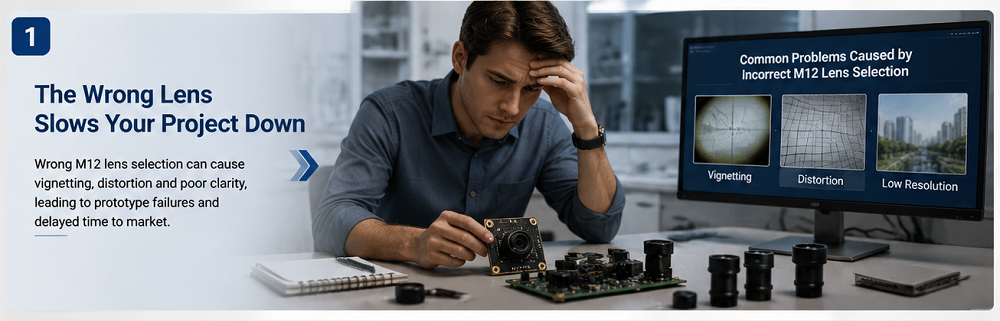
Selecting the right M12 optics lens is one of the most important steps in camera module development. Although M12 lenses are widely used because of their compact size, low cost and flexible focusing design, many camera projects still encounter problems during prototype testing, including image corner shading, insufficient resolution, incorrect field of view and poor sensor compatibility.
These problems usually do not come from the CMOS sensor itself. In many cases, the issue is a mismatch between the image sensor and lens optical design.
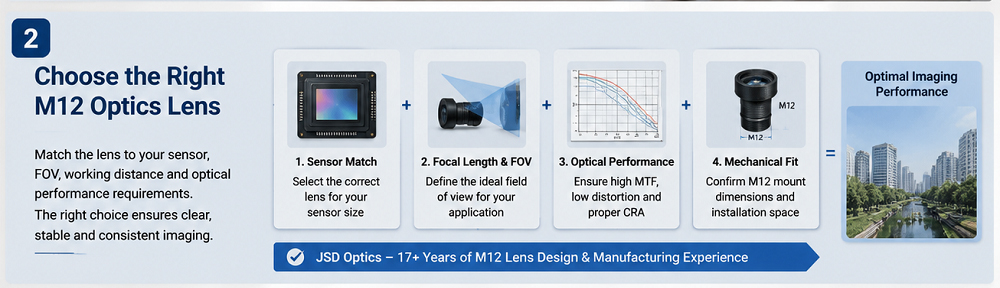
For example, a lens that performs well with a 1/2.8" sensor may show noticeable vignetting when installed on a larger 1/1.8" sensor. Similarly, high-resolution sensors with smaller pixel sizes require better MTF performance and accurate CRA matching to achieve their expected image quality.
As an experienced M12 lens manufacturer, JSD Optics has worked with camera module companies in machine vision, security cameras, robotics, UAV and embedded AI vision applications. Through years of optical design and mass production experience, we have found that successful lens selection should always start from the sensor specifications, application requirements and mechanical limitations.
This guide explains the key factors engineers should evaluate when choosing an M12 optics lens, including sensor compatibility, focal length, field of view, MTF, distortion, CRA matching and custom lens development options.
What Is an M12 Optics Lens?
An M12 optics lens, also called an S-mount lens, is a compact imaging lens with an M12×0.5 thread mounting structure. It is one of the most common lens standards used in small camera modules, embedded vision systems and industrial imaging devices.
Compared with larger C-mount or M16 lenses, M12 lenses are designed for applications where space, weight and cost are critical.
Typical applications include:
Embedded AI cameras
Machine vision modules
Security surveillance cameras
Robotics vision systems
UAV cameras
Smart IoT imaging devices
The popularity of M12 lenses comes from their balance between optical performance and mechanical flexibility. A camera module manufacturer can easily adjust focus during assembly and integrate the lens into compact product housings.
M12 Lens Mechanical Structure Explained
A standard M12 lens assembly usually consists of three main components:
M12 Lens Barrel
The lens barrel uses an M12×0.5 external thread, allowing direct installation onto camera module holders or PCB-mounted structures.
Lens Holder
The holder connects the optical lens with the camera PCB and maintains mechanical alignment between the lens center and image sensor.
Locking Ring
During production calibration, engineers adjust the lens position to achieve the required focus distance and then fix the position using the locking ring.
This simple structure makes M12 lenses highly suitable for mass production camera modules where fast assembly and focus adjustment are required.
Why Camera Module Manufacturers Choose M12 Lenses
Compact Design for Space-Limited Devices
Many embedded devices have strict mechanical limitations. Compared with C-mount lenses, M12 lenses offer a much smaller footprint, making them suitable for:
miniature AI cameras
wearable devices
drones
robot vision modules
Easy Focus Adjustment During Production
The threaded focusing mechanism allows manufacturers to calibrate image sharpness after assembling the camera module.
This is especially useful when:
PCB tolerances vary slightly
Different sensor batches are used
Different cover glass thicknesses affect optical performance
Mature Supply Chain and Cost Efficiency
M12 lenses have been widely adopted in consumer and industrial camera modules. Their standardized design enables:
faster sample delivery
stable production capacity
lower development cost
Compatibility With Popular CMOS Sensors
Most M12 lenses are designed for small and medium-format sensors, commonly including:
Sony IMX series sensors
OmniVision sensors
onsemi image sensors
However, compatibility depends not only on sensor size but also on pixel pitch, CRA requirement and optical performance.
 Consult now