JSD6010-A1 6mm M12 Lens: 8MP Low-Distortion Optics for Precision Machine Vision
JSD6010-A1 6mm M12 Lens: An 8MP, Low-Distortion Option Built for Precision Imaging
A compact 6mm, f/2.8 board-level M12 lens from JSD Optics with under 0.82% TV distortion, engineered for 1/1.8" sensors in measurement, inspection, and recognition systems.
Key takeaway: The JSD6010-A1 is a 6mm, f/2.8, 8MP M12 lens from JSD Optics designed around a 1/1.8" image circle (Ø9.0mm). With TV distortion under 0.82% and a 3G2P hybrid construction, it keeps image geometry honest — reducing calibration effort and improving measurement reliability across industrial inspection, license plate recognition, security, robotics, and medical imaging.
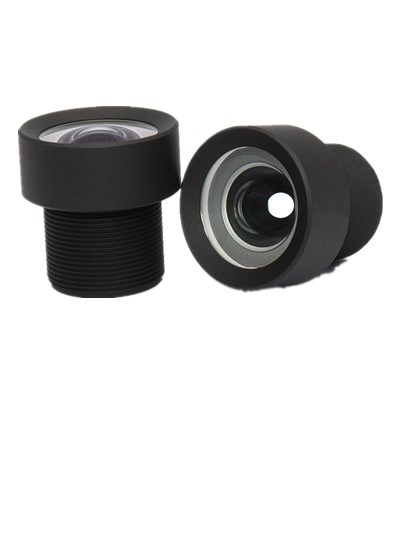
When "good enough" optics quietly add hidden costs
Most machine vision engineers have lived through a version of this scenario: the prototype performs well in the lab, the image looks sharp on the monitor, and then production begins. Calibration scripts grow longer, reject rates creep upward, and eventually someone identifies the root cause — the lens has been bending the image all along. Barrel distortion was eating into measurement accuracy, and the system was paying for it in software hours, tuning sessions, and scrap.
At that point, the requirement is not just another M12 lens. It is a lens that keeps the image geometrically honest — which is precisely what the JSD6010-A1 was designed to do.
This 6mm, f/2.8, 8MP M12 lens from JSD Optics pairs a compact board-level form factor with under 0.82% TV distortion. It suits industrial inspection, license plate recognition, and other applications where what the camera sees needs to match what is actually there.
The problem: distortion is the silent tax on vision systems
Many vision engineers point to resolution or lighting as the main factor in system accuracy. Distortion rarely gets the blame — until it does.
The numbers speak for themselves. A lens with 3–5% barrel distortion — common in many off-the-shelf 6mm designs — shifts pixels near the image edges by dozens of pixels on an 8MP sensor. For a measurement application, that is not a cosmetic issue. It is a systematic error present in every frame.
Correcting that error in software is possible, but it carries real costs:
Calibration effort. Each new working distance, lens unit, or focus setting may require re-calibration.
Processing overhead. Distortion correction consumes processing budget, which matters on high-throughput lines.
Edge-of-field risk. Some correction algorithms stretch or compress pixels in ways that can reduce the very accuracy they are meant to protect.
"The cleaner engineering approach is to begin with optics that distort the image less in the first place. That is not a marketing claim — it is the difference between correcting a problem and preventing it."
— JSD Optics Engineering TeamWhat to look for in an 8MP M12 lens for 1/1.8" sensors
Before examining the specifics of the JSD6010-A1, it is worth clarifying the selection criteria that matter for this class of lens. Knowing what to check makes datasheets easier to read and supplier conversations more productive.
1. Distortion control
For measurement, inspection, and recognition tasks, low distortion is a requirement rather than a luxury. Check the TV distortion specification and ask whether it applies across the full image circle or only the center.
2. Sensor size matching
The lens's image circle must cover the sensor's active area with margin. A 1/1.8" image circle (Ø9.0mm) pairs cleanly with mainstream 8MP sensors such as the Sony IMX334, IMX347, and OmniVision OS08A20. A mismatch between optics and sensor tends to produce vignetting and soft corners.
3. Chief Ray Angle (CRA)
CRA describes the angle at which light exits the lens and reaches the sensor. If it does not align with the sensor's microlens design, color shading and edge darkening can appear that ISP tuning may not fully remove. This specification is often overlooked — and it is a frequent source of late-stage issues.
4. Optical construction
Hybrid designs — glass elements paired with plastic aspherics — are common in this class. Glass contributes thermal stability, helping focus hold as the system warms up; plastic aspherics help correct aberrations that are harder to manage in all-glass designs.
5. Physical integration
For board-level cameras, the mount and total track length determine how the lens fits the housing. An M12 (S-mount) with a compact footprint keeps integration straightforward.
Keeping these five points in mind makes most datasheets read like a checklist rather than a maze.
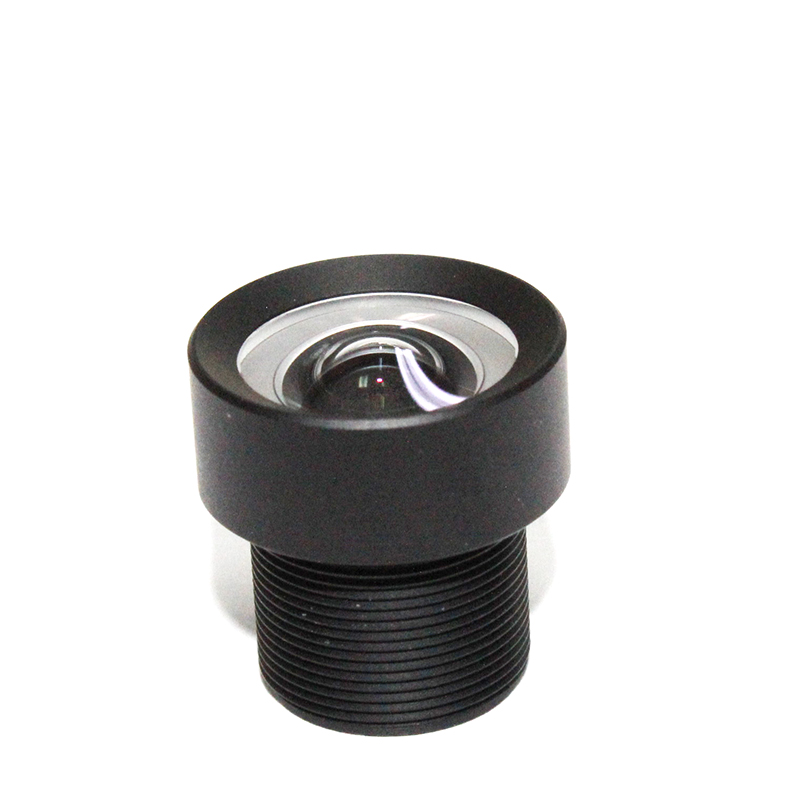
The JSD6010-A1: a closer look at the specs that do the work
Here is how the JSD6010-A1's design translates into things a system actually feels.
| Parameter | Specification | What it means for the application |
|---|---|---|
| Focal length | 6.00 mm | A moderate field of view that frames targets at medium working distances — wide enough for scene context, tight enough for detail |
| Aperture | f/2.8 | A balanced combination of light collection and depth of field for indoor and controlled outdoor lighting |
| FOV (D/H/V) | 78° / 60° / 40° | Predictable framing for gantries, fixed cameras, and robot-mounted units |
| TV distortion | < 0.82% | Near-rectilinear output — less reliance on software warping, simpler calibration, more trustworthy measurements |
| Resolution | 8 MP | Matches modern high-resolution sensors without becoming the limiting factor |
| Image circle | 1/1.8" (Ø9.0mm) | Clean coverage of mainstream 8MP sensors, including Sony and OmniVision families |
| Construction | 3G2P (3 glass + 2 plastic) | Thermal stability from glass, aberration control from aspherics |
| Mount / size | M12, φ16 × 23.1mm TTL | A compact form factor that fits standard board-level camera designs |
The benefit behind the numbers
The headline specification is not "6mm" or "f/2.8" — it is the <0.82% distortion. Many lenses in the 6mm range carry distortion well above 5%. That difference defines the purpose of this lens. On measurement or recognition applications, sub-1% distortion means pixels land where the geometry says they should, and software teams can spend time on algorithms rather than maintaining a warping table.
The 3G2P construction also matters. Plastic aspherics help correct aberrations that would otherwise require additional glass elements, while the glass elements help keep focus stable as temperature drifts — a relevant concern for outdoor ITS installations and enclosures that run warm.
Where the JSD6010-A1 earns its place
Different applications stress different specifications. The following covers how the JSD6010-A1 behaves where distortion and resolution tend to decide the outcome.
Industrial machine vision & inspection
The challenge: dimensional measurement and defect detection require geometric accuracy across the full field of view.
The payoff: low distortion reduces systematic measurement error, and 8MP resolution supports high-magnification inspection without upscaling artifacts.
License plate recognition (LPR/ANPR) & ITS
The challenge: plate text must remain legible across the frame, and edge distortion can garble characters at the extremes.
The payoff: the 60° horizontal FOV frames one to two traffic lanes comfortably, while low distortion keeps plate geometry stable for recognition algorithms.
Security & surveillance
The challenge: fixed cameras at medium range need enough detail for facial recognition without the exaggerated perspective of ultra-wide lenses.
The payoff: the 6mm focal length produces a natural, rectilinear perspective suitable for usable imagery, not an artificial fisheye look.
Robotics & AGVs
The challenge: robots need reliable object detection at medium working distances, often within tight mechanical envelopes.
The payoff: the compact M12 footprint simplifies mounting on arms and AGV decks, and stable image geometry makes sensor fusion and localization more predictable.
Medical & diagnostic devices
The challenge: imaging accuracy is a high priority, and software-based distortion correction is not always acceptable.
The payoff: sub-1% distortion supports accurate documentation and measurement where geometric fidelity matters.
JSD6010-A1 vs. the standard 6mm M12 lens
Not all M12 lenses are equal. The comparison below is intentionally direct:
| Aspect | Typical 6mm M12 lens | JSD6010-A1 |
|---|---|---|
| Distortion | Often 3–5% or higher | < 0.82% |
| Resolution headroom | 5MP or lower class | 8MP capable |
| Sensor matching | Generic, CRA often unverified | Designed for 1/1.8" sensors like IMX334/IMX347 |
| Engineering impact | Requires calibration and correction pipelines | Simpler calibration, more accurate edges |
| Best suited for | Cost-sensitive, accuracy-tolerant builds | Precision, measurement, and recognition applications |
The trade-off is straightforward: the JSD6010-A1 is not the least expensive M12 lens on the market, and it is not intended to be. It is built for systems where a 2% distortion error costs more than the lens itself. For those applications, it tends to be the more economical choice over the product's lifetime.
Engineering considerations when specifying the JSD6010-A1
A few practical notes help engineers specify with confidence.
Sensor pairing
The lens is optimized for 1/1.8" sensors. On slightly larger sensors such as the Onsemi AR0821 (1/1.7"), minor vignetting may appear at the extreme corners — a sample evaluation before design commitment is worth considering. For 1/1.8" sensors like the Sony IMX334, IMX347, or OmniVision OS08A20, the lens is well suited.
CRA confirmation
To confirm clean edges and minimal color shading, sharing the sensor model with JSD's engineering team is recommended. Confirming CRA matching early is a reliable way to avoid late-stage issues.
Variant confirmation
The "-A1" suffix typically denotes a specific configuration — for example, an IR-cut filter type or mechanical variant. Confirming the variant details when reaching out helps ensure the quotation reflects the right build for the lighting environment.
Environmental sealing
This lens is not IP67 rated. For outdoor ITS or washdown environments, housing-level sealing should be planned rather than relying on the lens alone.
Volume planning
For production quantities, early communication about annual volume helps JSD plan manufacturing and provide realistic lead times — which leads to the practical next step.
Why teams source from JSD Optics
Choosing a lens also means choosing a partner, because the cost of a poor match shows up on the production line rather than in the datasheet. Buyers who work with JSD Optics often treat the relationship as an engineering collaboration rather than a transaction.
Application support. JSD's team helps confirm sensor compatibility, CRA matching, and variant selection before a design is committed.
Customization capability. Custom barrels, adapter rings, coating requirements, and variant adjustments are part of the conversation.
Volume-oriented manufacturing. For companies planning 250, 500, or 1,000-unit annual quantities, JSD factors production planning into the quotation, aligning pricing with realistic lead times.
Technical honesty. The JSD6010-A1 is positioned as a low-distortion precision lens for specific applications, not as a universal solution. That clarity saves both sides time.
❓ Frequently Asked Questions
Answers to common questions about the JSD6010-A1 6mm M12 lens.
Is the JSD6010-A1 suitable for license plate recognition?
Yes. The combination of a 60° horizontal FOV, low distortion, and 8MP resolution makes it a good fit for LPR/ANPR cameras where plate legibility at frame edges matters.
Which sensors is the JSD6010-A1 compatible with?
It is designed for a 1/1.8" image circle, pairing well with sensors such as the Sony IMX334, IMX347, and OmniVision OS08A20. Slightly larger sensors such as the Onsemi AR0821 may show minor corner vignetting.
What makes this lens different from a standard 6mm M12 lens?
Primarily distortion control. At under 0.82%, distortion is noticeably lower than that of many typical 6mm lenses, which reduces calibration effort and improves measurement reliability.
Can the lens be customized for an application?
JSD Optics can discuss custom variants, including filter and mechanical configurations. Sharing application details with the sales team is the way to explore options.
How can pricing be obtained for the JSD6010-A1?
The JSD Optics sales team can be reached at jsdsales03@jsdoptical.com with the part number, target annual quantity, and sensor model. They can provide quotation and lead time information for the volume in question.
Getting a quotation for the JSD6010-A1
For teams evaluating the JSD6010-A1 for a production build, the direct route to pricing is a conversation with the JSD Optics sales team.
Email: info@jsdoptical.com
To speed up the quotation process, include:
Part number: JSD6010-A1
Estimated annual quantity (e.g., 250, 500, or 1,000 units)
Sensor model (e.g., Sony IMX334) to confirm CRA matching
Application and lighting environment to confirm the appropriate variant
Any custom requirements — coatings, barrels, sealing, or mounting
Whether the project is an inspection system, an ANPR camera, or a robotics platform, the JSD6010-A1 offers the geometric accuracy and 8MP resolution that precision applications depend on — supported by a team that treats production schedules as part of the equation.
The next step: contact the JSD Optics sales team with quantity requirements for pricing and lead times tailored to the volume. For teams still validating the fit, a sample or optical data can be requested to confirm sensor matching before commitment. Either way, the conversation starts with a single email.
Get a quotation for the JSD6010-A1
Send your sensor model and target annual volume — JSD's engineers will confirm CRA matching and provide pricing and lead times tailored to your build.
Or email us at info@jsdoptical.com
 Consult now