JSD4118 4.07 mm 130 deg M12 Lens for 1/1.8 inch 12MP
JSD4118 on SONY IMX678: The Real Field of View Behind the 130° Spec
A 4.07 mm M12 lens that lands 111° horizontal on a 1/1.8" 16:9 sensor — what that leaves on the vertical axis, and what the housing inherits.
Requirement: a 4K camera module on the IMX678 that gains horizontal coverage without giving up frame corners. Answer on this sensor: 130° diagonal, 111° horizontal and 61.2° vertical, with a Ø9.1 mm image circle against an 8.81 mm sensor diagonal, in an M12×P0.5 barrel of 24.47 mm total track length and manual focus. What decides the purchase: 111° horizontal is the figure to design against, and where it falls short the φ17 mm barrel of JSD1537 drops into the same holder pocket and buys field of view at a higher distortion cost.
Why Horizontal FOV Decides the Design, Not the 130° on the Box
M12 wide-angle lenses are usually sold on diagonal field of view, because it is the largest figure a spec sheet can print. Layout work runs on a different value: horizontal coverage at the distance where the subject sits. The same optic covers a different width depending on the sensor bonded behind it, so a 130° label describes the lens rather than the camera.
The IMX678 makes that gap easy to underestimate. It is a 1/1.8" part with a 3840×2160 array and an 8.81 mm diagonal, which in 16:9 reads 7.68 mm across and 4.32 mm up. Vertical is the shorter leg, so with mounting height fixed the floor line in front of the camera leaves the frame before the side walls do. Drawing the 111° × 61.2° cone at the planned mounting height, and marking where the near-field floor should fall, tends to settle the mounting question faster than another lens comparison: a candidate that is three degrees wider rarely rescues a scene that needs ten more degrees of vertical coverage.
Measurement convention is the other item worth fixing before candidates are ranked. Two suppliers can both state 130° and mean different frames — an optical full field read on a flat target, or a corrected field after the camera's own distortion handling has cropped the edge pixels. Both figures can be honest and they are still not interchangeable. Ask which one a quoted number refers to before it enters a comparison table, otherwise the shortlist ends up ranked on arithmetic instead of coverage.
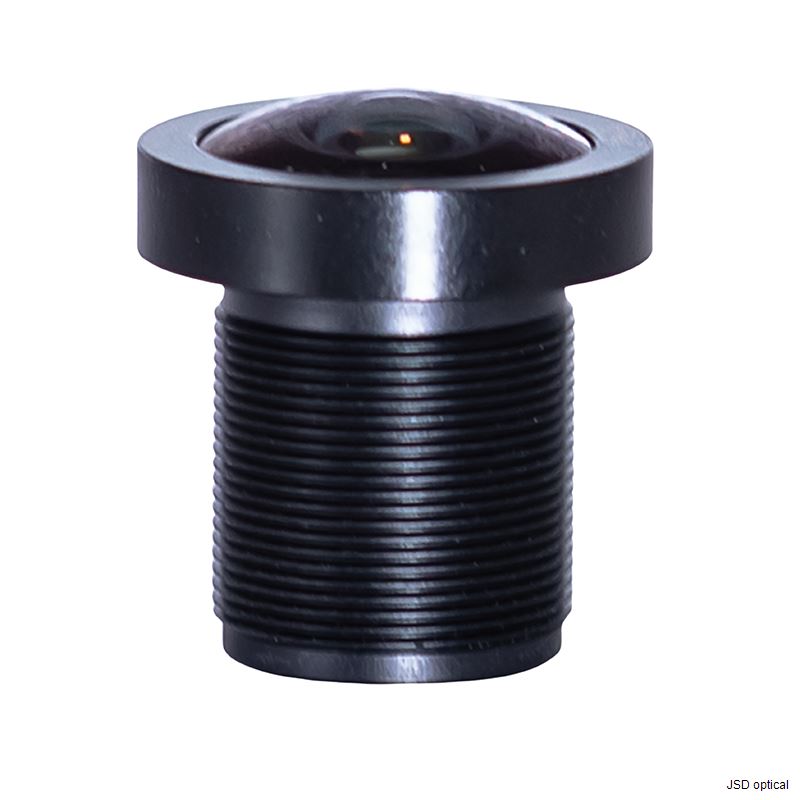
The JSD4118 Field of View on SONY IMX678, in Numbers
JSD4118 is a 4.07 mm F1.8 fixed-focal lens built for 1/1.8" sensors. On the IMX678 the figures that drive layout and procurement decisions are these:
| Parameter | Value on SONY IMX678 (1/1.8", 16:9) | What it moves in the design |
|---|---|---|
| Diagonal FOV | 130° | Extreme-corner coverage; the catalogue figure, not the layout figure |
| Horizontal FOV | 111° | Scene width per unit, and how many cameras a corridor needs |
| Vertical FOV | 61.2° | Near-field floor and mounting height before the horizon line is lost |
| EFL / aperture | 4.07 mm / F1.8 | Depth of field and low-light headroom on a STARVIS 2 class sensor |
| Image circle | Ø9.1 mm | Sensor diagonal is 8.81 mm, so the array sits inside the circle |
| Distortion | <−15.6% | Firmware correction load, and how much of the frame survives it |
| Mount / TTL | M12×P0.5 / 24.47 mm | Holder geometry, focus travel and total module height |
| Construction | 3G4P | Glass-to-plastic balance across temperature and focus drift |
The 0.29 mm margin between that Ø9.1 mm image circle and the 8.81 mm diagonal carries two jobs. Optically it holds the 3840×2160 corners away from the edge of the field, where vignetting and corner softness surface first. Mechanically it absorbs part of the holder's centring tolerance, which is why a design that clears the diagonal by a hair on the drawing can still show a dark wedge in production. Identification footage — faces, plates, doorframes — is what a tight image circle damages first.
Field of view figures are optical values referenced to a 1/1.8" 16:9 target. Camera-side lens distortion correction, digital zoom and edge cropping will reduce the effective frame, so final acceptance should be agreed against the test conditions on both sides.
— JSD Optics application engineering noteFreezing the method is what turns that note into something enforceable. A repeatable acceptance test fixes the target type and target distance, states whether firmware dewarping is on, and defines how the horizontal angle is read off the captured frame. Two suppliers can each honour 111° and still ship visibly different frames when one measures the optical field and the other measures the processed image. The method belongs in the purchase specification, not in the correspondence that follows a rejection.
Reading the Drawing: 24.47 mm TTL and a φ17 mm Barrel
Optical figures decide whether a lens is right; the barrel decides whether it fits, focuses and holds that focus. Three dimensions carry most of the integration risk:
Total track length, 24.47 mm — front vertex to image plane. It sets the minimum front-housing depth and, together with the holder, the total module stack. An enclosure already tooled around a shorter lens is the most expensive place to discover this number.
Barrel diameter, φ17 mm — the front element, and the physical reason 130° of diagonal is available on a 1/1.8" format. A wide design needs that much glass; a bezel opening tighter than the element clips the field, and a lens behind a restricted opening delivers whatever the opening allows.
M12×P0.5 thread with manual focus — 0.5 mm pitch is the standard S-mount, so thread engagement and lock-screw practice carry over from existing module lines. Manual focus makes focus a process step: set it at the deployed distance, then lock it.

Focus and lock: a sequence that survives transport
Dry-mount first — thread the lens into the holder without adhesive and confirm usable focus travel in both directions. A lens that reaches focus only at the end of its thread has already spent the tolerance budget of the stack.
Set focus at the deployed distance — a 4K array shows focus error at the frame edges, so a bench target half a metre away is not a proxy for a scene twelve metres out. Judge edge sharpness, not only the centre.
Lock, then re-verify — thread-locking compound or a set screw, followed by a second edge-sharpness check. Transport vibration is the usual reason a unit that passed at the factory arrives soft in the field.
When 111° Horizontal Is Not Wide Enough
111° horizontal suits 4K coverage of a wide scene that still has to stay readable per pixel. Where the requirement is genuinely panoramic — a whole yard in one frame, a 180°-plus sweep — changing the lens usually costs less than changing the camera platform, because sensor, ISP and housing approvals survive the swap. The models most often weighed against an IMX678 project:
| Model | Diagonal / Horizontal / Vertical | Mount and envelope | When it is the right move |
|---|---|---|---|
| JSD4118 | 130° / 111° / 61.2° | M12, φ17 mm, 24.47 mm TTL, F1.8 | Baseline wide coverage with a correction load a standard ISP budget can carry |
| JSD1537 | 146.1° / 123.9° / 66.4° | M12, φ17 mm, 24.4 mm TTL, F1.5 | More width inside the same barrel envelope; the faster aperture helps low light and asks more of correction |
| JSD3008 | 162° / 139° / 80° | M12, φ14 mm, 16.0 mm TTL | Distinctly wider and a much shorter stack, where the housing can accept a smaller front element |
| JSD2917 | 196° / 166° / 91° | M12, F1.6, sealed barrel rating | Panoramic and fisheye work with the lens exposed and moisture a real risk |
| JSD2916 | 190° / 158° / 83° | M12, 12MP class, sealed barrel rating | Panoramic coverage with pixel headroom left over for dewarping |
Width and straight lines pull against each other, so a fisheye-class lens is not a drop-in replacement where lane markings or building edges have to stay straight after correction. An ingress protection rating is likewise a per-model attribute rather than a family trait: JSD4118, JSD1537 and JSD3008 are unsealed barrels and belong behind a window, dome or front glass. Only the sealed panoramic models are candidates when the lens faces weather directly.
Swapping JSD4118 for JSD1537 is the small-change route — same M12 thread, same φ17 mm diameter, a track length 0.07 mm shorter — so holder and tooling stay. Two items still need re-confirming afterwards. A shorter barrel changes thread engagement and the assembly station's focus setting becomes a new value, not a carry-over. Corner rendering changes as well: 123.9° horizontal pushes more of the scene into the region where resolution and distortion are least comfortable, which is why the wider model suits scene coverage better than line reading.
Distortion, Resolution and Acceptance Testing
At 4.07 mm and 130° diagonal, <−15.6% barrel distortion is the optical cost of the field rather than a manufacturing fault. The practical question is whether the pipeline and the scene can absorb it, and three considerations usually settle that on an IMX678 evaluation:
Where the distortion sits — barrel drawing is not uniform: the bend grows toward the frame edge, so a low-order correction model leaves its largest residual in the corners. Scene monitoring carries that residual. Measurement, lane geometry and anything that must keep straight lines straight carries it poorly.
Corner resolution — a lens matched to the 8.29 MP frame is characterised at the centre by definition, and the corners are where candidates separate. Judge that at the deployment focus distance from an edge crop, not from a centre crop.
Relative illumination — wide field plus small pixels makes vignetting visible twice: as corner noise first, in low light, and as a dark corner only in daylight. On a STARVIS 2 class sensor the low-light reading is the one that decides.
Corner resolution and relative illumination belong to the fitted assembly — lens, sensor board, IR-cut decision and working distance together — so the dependable answer comes from a sample on the target board rather than from a datasheet curve. A lens picked for maximum width is often the wrong lens for a scene that needs clean straight lines.
What to send with a sample request
Sensor and resolution, plus the aspect ratio the ISP outputs — full 16:9 or cropped
Target horizontal and vertical field of view, and the distance at which each has to hold
Existing mechanical envelope: barrel diameter, thread engagement, flange-to-image allowance
Whether the lens sits behind a window or faces weather, and the enclosure rating it must reach
Correction plan: on-camera dewarping, server-side, or none
Those five answers typically settle the JSD4118-versus-wider question before a sample ships, rather than after one is rejected.
❓ Frequently Asked Questions
Short answers to the questions engineers ask before they request a JSD4118 sample.
What is the field of view of JSD4118 on the SONY IMX678 sensor?
On the SONY IMX678 in 16:9 the optical field of view is 130° diagonal, 111° horizontal and 61.2° vertical.
Will JSD4118 crop or vignette the corners of a 1/1.8" sensor?
No. The image circle is Ø9.1 mm against a 8.81 mm sensor diagonal, so the full 3840×2160 array sits inside it with a 0.29 mm margin.
Can I get a wider field of view without redesigning the housing?
Usually yes. JSD1537 shares the M12 mount, the φ17 mm barrel diameter and a 24.4 mm track length, and widens coverage to 146.1° diagonal and 123.9° horizontal with a faster F1.5 aperture.
Does the camera firmware need to correct distortion?
JSD4118 measures <−15.6% barrel distortion. Scene monitoring generally carries that much. Measurement, lane geometry and any application that depends on straight lines need dewarping, and the correction plan belongs in the firmware budget from the start.
Confirm the field of view on your sensor board
Share your sensor, target FOV and mechanical envelope, and the engineering team will confirm the lens choice and the test conditions for acceptance.
Or email us at info@jsdoptical.com
 Consult now