JSD2639 2.10mm M12 Wide-Angle Lens 116 deg for 1/2.8in 8MP
JSD2639: a 2.10 mm M12 lens that puts 116° diagonal view on a 1/2.8 inch 8MP sensor
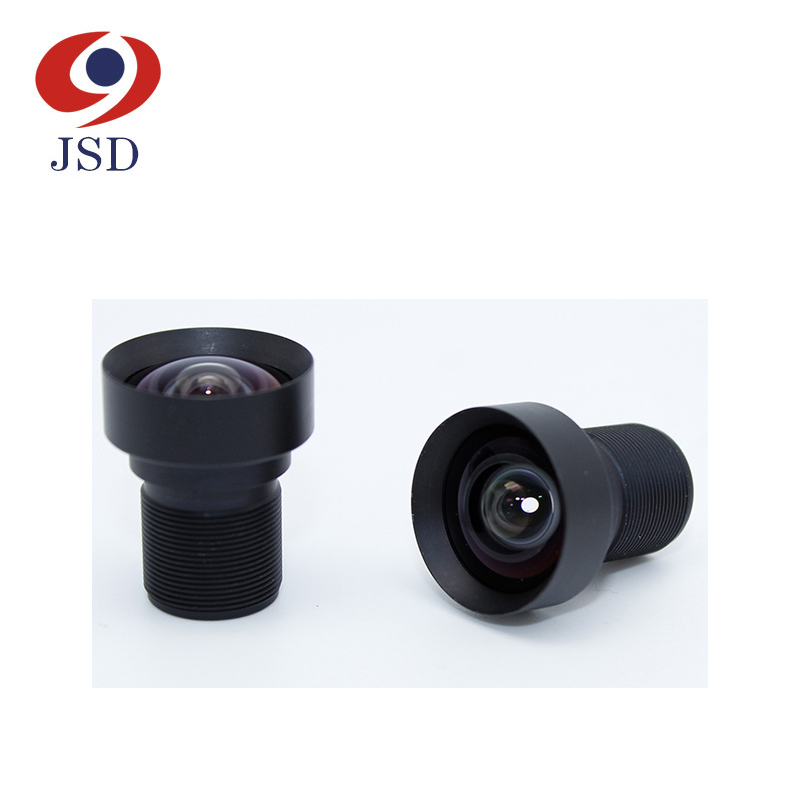
Six elements in a 17.5 mm barrel, 24.5 mm total track — a frame wide enough for a whole doorway from a lens that still sits behind a sealed front panel.
Key takeaway: JSD2639 is a 2.10 mm, F2.4 M12 (S-mount) prime for 1/2.8 inch 8MP sensors: 116° diagonal, 107° horizontal and 71° vertical field of view, measured TV distortion of -4% (barrel), a 6.8 mm image circle, a 17.5 mm barrel and a 24.5 mm total track. It answers one situation — a frame wide enough for a doorway, a pallet or the end of a shelf, inside an enclosure that is already tooled and already sealed.
Why 116° is hard to combine with an 8MP sensor
A 1/2.8 inch board that carried 2MP now carries 8MP, and nothing around it grew: not the board, not the lens mount, not the opening in the front panel. The expectation grew instead — the same camera is now asked to read a whole shelf, a whole pallet or a whole doorway from a position 20 mm or so behind that panel.
Widening the field is where the expectation meets the optics. Pulling the focal length down spreads the image over the full sensor diagonal, and a short four-element design pays for that spread in the corners: they soften while the centre stays sharp, so usable area falls back toward what the older optic already delivered. Push the focal length down further and the barrel lengthens, which means cutting a deeper pocket into a housing that has already been tooled.
Three failure modes recur in first-article reviews:
Reusing an optic built for a smaller sensor. An image circle sized for 1/3 inch leaves the 1/2.8 inch corners dark, and gain applied in software does not recover a frame edge that was never imaged.
Sizing the housing from another model's drawing. Internal depth follows total track, not focal length, and the two do not scale together across a range.
Treating every M12 thread as interchangeable. The M12 x P0.5 pitch is standard for this family; the barrel diameter behind the thread is what collides with the holder skirt.
“Wide angle is not a lens property on its own. It is a property of lens plus sensor size, read off the diagonal — which is why the JSD2639 figures only mean something once the 1/2.8 inch target is fixed.”
— JSD Optics application engineeringThe JSD2639 numbers that decide your design
Each row below pairs a figure with the decision it constrains. The constraint, not the number, is what has to be accepted before a housing is released for tooling.
| Parameter | JSD2639 | What it changes in your build |
|---|---|---|
| Effective focal length | 2.10 mm | Sets how much scene lands on the sensor at a given working distance; shorter pulls more into frame and moves the front element closer to the target. |
| Aperture | F2.4 | Balances light gathering against depth of field; the working range that matters when subject distance varies by tens of millimetres. |
| Field of view (1/2.8 inch) | 116° D / 107° H / 71° V | The horizontal figure decides whether the target fits left to right; the vertical figure sets how much of a tall shelf or door frame stays in frame. |
| TV distortion | -4% (barrel, measured) | Predicts how much straight-line bending appears at the frame edge, and therefore how much correction the image pipeline has to carry. |
| Image circle | 6.8 mm | Has to cover the sensor diagonal; a smaller circle vignettes at the corners regardless of how sharp the centre is. |
| Optical construction | 6 elements, mixed glass and plastic | Element count and material mix set how much of the wide field stays corrected out to the corner. |
| Mount | M12 (S-mount) x P0.5 | Drops into the standard M12 holder and the focus-setting fixture already on the line. |
| Barrel diameter | 17.5 mm | Sets the clear bore in the front panel and the skirt clearance around the holder. |
| Total track length | 24.5 mm | Sets the minimum internal depth from front panel to sensor face; this is the figure that decides whether an existing enclosure survives. |
| Resolution | 8MP | Matched to sensor density; a lower-resolution optic discards pixel count already paid for. |
| Sealing | Sealed barrel construction | Lets the lens opening be treated as part of the sealed envelope rather than a leak path; test conditions are confirmed per project. |
Barrel, thread and total track: the mechanical envelope
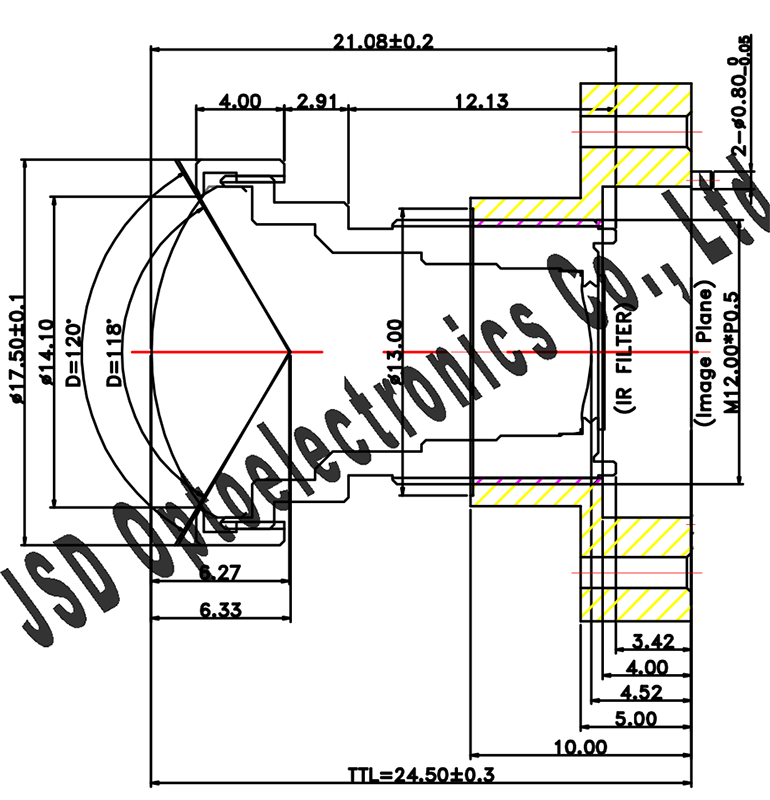
Optical figures are usually accepted within one review cycle. The project then stalls on a narrower question: does the lens fit the enclosure the product team already signed off. Three dimensions settle it, and all three come off the drawing rather than the marketing table.
The 17.5 mm barrel is the industrial designer's number. It sets the clear bore in the front panel and the wall thickness that bore leaves room for; on a door-mounted or handheld product, a millimetre and a half of extra wall is often what separates a mould that seals from one that flexes when the bezel is screwed down.
The 24.5 mm total track is the mechanical engineer's number. It runs from the front of the lens to the image plane, so the pocket behind the panel equals total track minus however far the barrel is threaded in. Teams that budget from focal length instead of total track tend to meet the error at first article, when the holder cannot seat deep enough to reach focus.
The M12 x P0.5 thread is manufacturing's number. The focus-setting station, the locking compound process and the holder inventory all carry over, so a focal length change does not by itself trigger a line re-qualification.
What the drawing does not settle
Back focal length is quoted per project rather than published as a fixed figure, because it depends on the holder and the filter stack inside the camera. Send the holder drawing and the filter thickness with the enquiry and the focal position can be pinned down in one pass rather than across three sample rounds.
What -4% distortion really costs
-4% is what the image pipeline inherits. Barrel distortion bends straight lines outward by roughly 4% of the field at the frame boundary, so the edge carries a geometric offset that the centre does not. A viewing camera absorbs that without anyone noticing; a measuring camera books it as a calibration item, and the cost of booking it after the routine is frozen is a rewrite.
The arithmetic is worth doing before the decision rather than after it. Four percent of edge displacement across a 1 m field comes out at roughly 40 mm of apparent position error at the boundary — enough for a tolerance that holds in the centre to fail at the frame edge.
Two qualifiers keep the figure honest. Distortion is measured under stated conditions, and those conditions are not identical across the catalogue, so ranking two models by a single percentage misleads. Barrel distortion also concentrates at the edge, which means a task reading the central band works with a cleaner image than the full-frame number implies.
| Route | Implementation cost | Where it fits |
|---|---|---|
| Correction model in the pipeline | A calibration step per camera plus a resampling pass on every frame, with fixed-point handling on constrained hardware | Measuring tasks that need the whole frame, corners included |
| Crop to the centre band | Nothing to implement, but field width and usable pixel count both shrink with the crop | Tasks that only need the middle of the scene, where geometry stays tight |
| A lower-distortion sibling in the same family | No software step, but field, aperture or barrel envelope changes with the model | Measurement lines that can trade field width for edge geometry |
When the edge, not the field, is the binding constraint
Distortion, aperture and field sit on the same bench: pulling one moves the other two. Where a measuring task cannot absorb a resampling pass, the practical answer is a different point on that bench rather than a longer calibration routine. The FAQ below maps the siblings in this 1/2.8 inch 8MP family to the workloads they suit, so that comparison is made once, beside the questions buyers actually ask.
Where the JSD2639 fits
Mobile robots and docking stations
An AMR reading a fiducial or a charging contact from half a metre needs a wide frame and a short barrel that tucks into a low-profile housing. At 24.5 mm total track the camera module sits flush inside the chassis skirt, with no bulge for a pallet to catch.
Embedded vision boxes and edge AI cameras
These boxes are tight on heat and on volume at the same time. A 17.5 mm barrel and a six-element stack leave room for a heatsink, and the 8MP rating matches the sensors the boxes already carry, so the pipeline keeps its pixel count instead of downsampling to stay sharp.
Access control, door and shelf cameras
A camera covering a doorway or a 1.2 m retail shelf is decided by the horizontal figure, not the diagonal one. At 107° horizontal, one unit covers what a fixed 2.8 mm layout splits across two cameras, which removes a synchronisation problem along with a bill-of-materials line.
Robotic pick-and-place with a short working distance
With the gripper sitting in front of the lens, the frame has to work around it. A 2.10 mm focal length still takes in the part and the fixture reference together, and F2.4 keeps depth of field usable across the few centimetres the part travels in Z.
Selection checklist before you commit
Six checks settle most mismatches between this lens and a real camera build. Each one needs a drawing or a datasheet, not a sample.
Confirm the sensor diagonal. The 6.8 mm image circle is sized for 1/2.8 inch; a 1/2.3 inch sensor has a longer diagonal and would vignette. This check runs before any other.
Compute the field at the real working distance. Use the horizontal and vertical angles against the actual mounting height; 107° horizontal at 400 mm frames a different job from the same figure at 1.5 m.
Book the distortion correction. Decide whether the pipeline carries a -4% barrel model or the task crops to the centre, and decide it before the calibration routine is written.
Compare pocket depth with 24.5 mm total track. Subtract the threaded engagement, then compare against the space behind the front panel. This is the check that saves a tooling revision.
Leave bore clearance around 17.5 mm. Add wall thickness and any bezel chamfer, then confirm the holder skirt clears the panel.
Send the holder and filter stack for focal confirmation. Back focal length is quoted per project, so focal position is confirmed against the actual camera rather than a generic assumption.
Items outside the specification table — coating, relative illumination, chief ray angle against a specific sensor, infrared configuration and the exact sealing test conditions — are quoted per project. Naming them in the first enquiry is faster than meeting them at first article.
❓ Frequently Asked Questions
The questions engineers ask most often before they request a sample of the JSD2639.
What sensor size does the JSD2639 cover?
A 1/2.8 inch sensor at 8MP, covered by a 6.8 mm image circle, with 116° diagonal, 107° horizontal and 71° vertical field of view on that format. The 107° horizontal figure is also published for the Sony IMX415, and chief ray angle matching for a specific sensor part is confirmed per project.
What does the -4% distortion figure mean in practice?
It is the size of the calibration item rather than a defect: barrel distortion bends straight lines outward by about 4% of the field at the frame boundary, so the edge carries a geometric offset the centre does not. Viewing tasks absorb it without a visible effect; measuring tasks either carry a correction model or read the centre band.
Can the JSD2639 replace a 2.8 mm M12 lens directly?
Mechanically it usually can, because both use the M12 x P0.5 thread and the existing holder and focus station carry over. Optically the field changes: 2.10 mm on a 1/2.8 inch sensor gives 116° diagonal where a 2.8 mm prime frames tighter. Two dimensions decide whether the swap is really a drop-in: the 17.5 mm barrel against the front-panel bore, and the 24.5 mm total track against the pocket depth.
Which JSD lens should be chosen if distortion or field width is the priority?
Inside the same 1/2.8 inch 8MP family the trade sits in three places. The JSD2631 holds distortion below 1.5% in a 16 mm barrel for dimensional measurement with a narrower field; the JSD2636 reaches 129° where coverage outranks edge geometry; the JSD2629 keeps the 116° field at F2.0 for dim scenes where depth of field can be traded. The JSD2639 stays the wide-and-compact point between them.
Is the JSD2639 sealed for outdoor and washdown housings?
The lens is supplied in a sealed barrel construction, so the lens opening can be treated as part of the sealed envelope instead of a leak path between panel and sensor. Test conditions for that sealing are confirmed per project, and the enclosure around the lens still has to be designed as a sealed assembly on its own terms.
What information is needed to confirm the JSD2639 for a specific camera?
Four inputs settle most of it: sensor part number, working distance range, holder drawing and filter stack thickness. From those, focal position, field at the real working distance and front-panel bore can be confirmed in writing before a sample is built.
Check the JSD2639 against your camera
Send the sensor part number, working distance and holder drawing: focal position, real-distance field and housing envelope come back in writing.
Or email us at info@jsdoptical.com
 Consult now