1/1.8" Sensor Showcase: Comparative Field Test Data for Mainstream 8MP Lenses
In modern high-end vision solutions, the 1/1.8" format has become the "Golden Standard" for 4K (8MP) resolution. Compared to 1/2.8" sensors, it offers a larger photosensitive area and superior dynamic range. However, such large-format sensors place extreme demands on the M12 Lens. This article focuses on mainstream 8MP-grade sensor models (such as the Sony IMX334, IMX485, etc.), using comparative field test data to reveal how to precisely select the optimal lens solution.
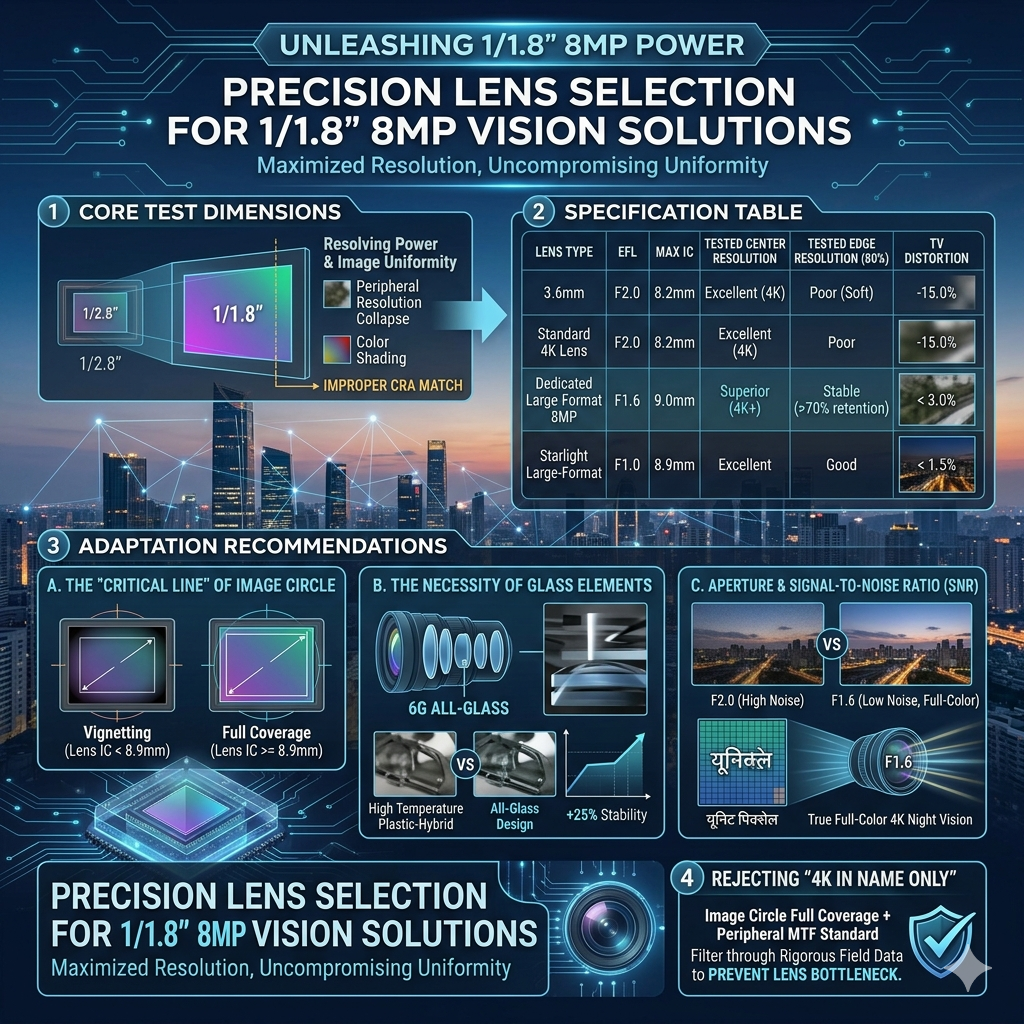
1. Core Test Dimensions: Resolving Power and Image Uniformity
In our field tests for 8MP applications on 1/1.8" sensors, we identified two frequently overlooked "pitfalls":
Peripheral Resolution Collapse: Many lenses claiming 4K support experience a resolving power drop of over 60% at the edges of a 1/1.8" sensor (at a diagonal of approximately 8.9mm).
Color Shading: The incident angle of light at the edges of a large-format sensor is significant. If the lens CRA (Chief Ray Angle) is improperly matched, noticeable color shifts will occur in the periphery.
2. Specification Table: Comparative Field Test Data for Mainstream 8MP M12 Lenses
The following table summarizes laboratory performance results for three mainstream M12 lens categories paired with a 1/1.8" 8MP sensor:
Lens Type | Focal Length (EFL) | Aperture (F/No) | Max Image Circle (IC) | Tested Center Resolution | Tested Edge Resolution (80% Field) | TV Distortion |
Standard 4K Lens | 3.6mm | F2.0 | 8.2mm | Excellent (4K) | Poor (Soft) | -15.0% (Typical Wide) |
Dedicated Large-Format 8MP | 4.0mm | F1.6 | 9.0mm | Superior (4K+) | Stable (>70% retention) | < 3.0% (Low Distortion) |
Starlight Large-Format | 6.0mm | F1.0 | 8.9mm | Excellent | Good | < 1.5% |
3. Lens Adaptation Recommendations for 1/1.8" Sensors
To maximize the performance of a large-format 8MP sensor, focus on these critical expansion details during selection:
A. The "Critical Line" of Image Circle Diameter
Field tests prove that when pairing with models like the IMX334, the M12 lens image circle must be ≥ 8.9mm$. Many lenses on the market labeled for 1/2" sensors will exhibit obvious dark corners (vignetting) when used on a 1/1.8" sensor.
B. The Necessity of Glass Elements
1/1.8" 8MP solutions are frequently deployed in outdoor surveillance or industrial inspection. Comparative data shows that All-Glass (6G or 7G) designs offer 25% higher clarity stability in high-temperature environments compared to plastic-hybrid lenses. For 4K solutions—which are extremely sensitive to pixel shift—All-Glass lenses are a prerequisite for "production-grade" delivery.
C. Aperture and Signal-to-Noise Ratio (SNR)
In testing, F1.6 large-aperture lenses reduced nocturnal noise by approximately 40% compared to F2.0 lenses when paired with 1/1.8" sensors. Since 1/1.8" sensors already feature larger unit pixels, coupling them with high-flux lenses enables true full-color 4K night vision.
4. Rejecting "4K in Name Only"
For 1/1.8" 8MP solutions, the core of selection lies in two factors: the image circle must provide full coverage, and the peripheral MTF must meet the standard. Only by filtering through rigorous field test data can you prevent a lens bottleneck from forcing a premium sensor to output entry-level image quality.
 Consult now