Common Misconceptions and Clarifications of Focal Length, Zoom, and Focus
"Focal length" and "focus" are the most basic concepts we regularly encounter. However, many beginners and even some enthusiasts easily confuse them—for example, mistakenly believing that the distance from the lens to the imaging plane is the focal length, or that turning the focus ring changes the focal length. These understandings are actually inaccurate. Today, the author will sort out these core concepts; feel free to discuss any questions.
What is Focal Length?
Focal length is an inherent property of an optical system that measures the light-gathering ability of a lens (or lens element).
Physical definition:For a thin lens or an idealized lens system, the focal length is the distance from the optical center of the lens (simply understood as the midpoint of the lens) to the focal point.
What is a focal point?When a beam of light parallel to the principal axis (such as starlight from infinity) passes through the lens, it converges to a single point on the principal axis—this point is the focal point. The plane where this focal point lies is the focal plane, which is fixed in an ideal optical system.
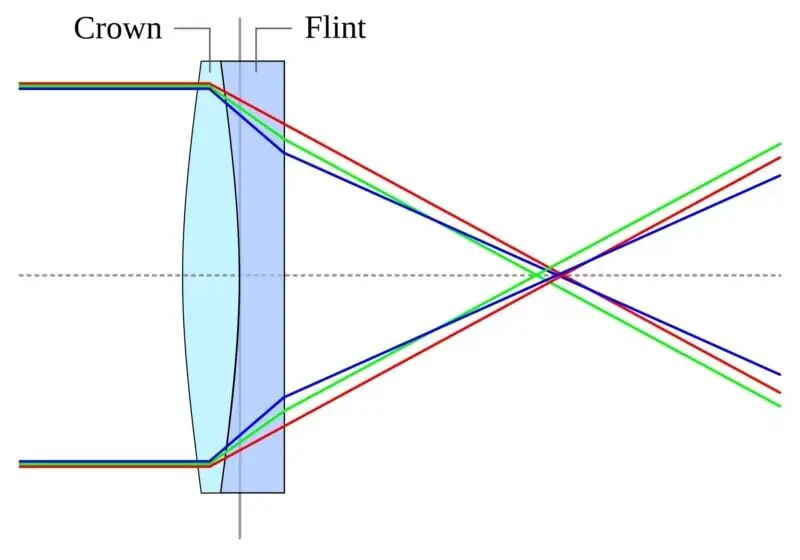
Key point:Focal length is a fixed value describing the lens itself, much like a person’s height. A 50mm lens always has a focal length of 50mm; it does not change depending on how far or near your subject is.
Are Optical Focal Length and Photographic Focal Length the Same?
They are essentially the same concept, with subtle differences in interpretation and application.
Focal length in optics (physics):A pure, idealized theoretical parameter that ignores complex lens structures (multiple elements), focusing mechanisms, etc. It is the most fundamental property of a lens.
Focal length in photography:The practical application and extension of optical focal length in photography.When we say “this is a 24–70mm zoom lens”, we refer to its focal length range.In photography, focal length takes on intuitive visual meaning:
Angle of view: Focal length determines how wide the lens “sees”. Shorter focal lengths (e.g., 14mm) give a wider view; longer focal lengths (e.g., 200mm) give a narrower view and “bring distant objects closer”.
Perspective and space: Short focal lengths exaggerate the near large/far small perspective, creating strong depth; long focal lengths compress space, making foreground and background appear closer together.
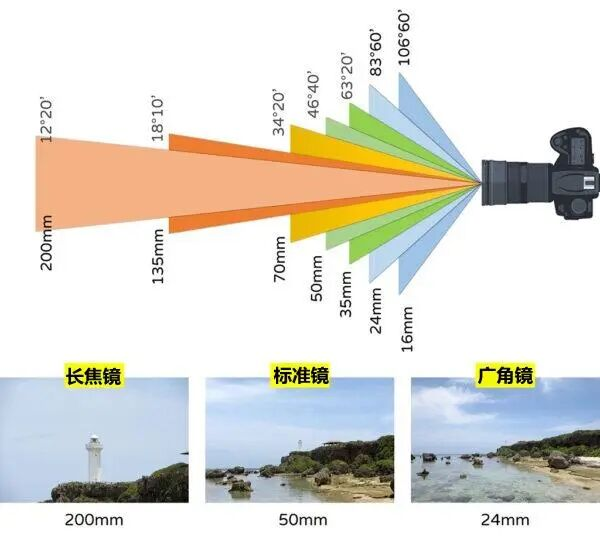
In short:Photographic “focal length” borrows the physical optical concept to describe the lens’s field of view characteristics.A 50mm lens has a physical focal length of 50mm and is called a “standard lens” in photography because its angle of view is close to that of the human eye.
Relationship Between Focal Length, Object Distance, and Image Distance in Photography
The sharpest image formed by a camera lens does not usually fall exactly on the focal point.In other words, the distance from the sharp image to the optical center (image distance v) is generally not equal to the focal length f, but slightly larger.This distance depends on the distance from the subject to the lens (object distance u).As object distance increases, image distance decreases (but is always greater than the focal length in practice).
They are strictly bound by the Gaussian lens formula:u1+v1=f1Where:
f: focal length — an inherent, constant property of the lens.
u: object distance — distance from the subject to the lens’s optical center; varies with shooting distance.
v: image distance — distance from the sharp image plane (sensor/film) to the lens’s optical center; changes with object distance.
When shooting distant objects (u is very large, approaching infinity), 1/u≈0, so v≈f.This is why we say “the focal point lies on the focal plane”.
When shooting close objects (u decreases, e.g., macro photography), 1/u increases.To satisfy the equation, 1/v must also increase, meaning image distance v must be larger than focal length f.This is why macro lenses extend significantly: to increase image distance.
Misconceptions: Focus vs. Zoom
Zoom: Changes the focal length (f) of the lens.For example, turning from 24mm to 70mm to bring the subject closer.Usually adjusted via the zoom ring.
Focus: Changes the image distance (v).Focal length remains unchanged; lens elements are moved to form a sharp image on the sensor.This process of adjusting image distance is what we call focusing, usually done via the focus ring.
Summary Table
| concept | symbol | definition | changed | Its manifestation in photography |
| focal length | f | The inherent properties of a lens, the distance from the point where parallel light converges to the center of the lens. | constant | The numbers on the lens (e.g., 50mm) indicate the perceived width of the angle of view. The longer the focal length, the farther the image is zoomed in, and the stronger the background blur. |
| Object distance | u | Distance from the subject to the center of the lens | Changes in footwork | Your distance from the subject. The closer the subject, the shallower the depth of field (the more blurred the background). |
| Image distance | v | Distance from the clear imaging plane (sensor) to the center of the lens | Through focus/adjustment changes | When a camera focuses, the movement of the lens elements or the entire lens barrel is used to adjust it. The closer the object being focused on, the greater the image distance. |
In short:
Focal length (f) is like the lens’s ID — fixed.
Object distance (u) is determined by shooting distance.
Focusing is the process of adjusting image distance (v) to satisfy the lens formula and achieve a sharp image.
Mastering these relationships directly improves your practical photography:
1. Macro photography: Why do macro lenses extend so much?Because object distance (u) is extremely small, so image distance (v) must increase greatly—sometimes requiring extension tubes to artificially increase image distance.
2. Background blur control:For strong background blur, besides using a wide aperture, you can also increase focal length (f) or decrease object distance (u) (move closer).
 Consult now